About Celeste Horner

Celeste Horner is a long-time student of language. She was born in New York state, and grew up
in the eastern townships of Quebec, south of Montreal, where there was both English and French culture.
She was fascinated by the world, and visited Egypt and Europe with her family. Celeste's father, Carl, was
an IBM engineer (Mr. graph paper and slide-rule, vanguard of transition to electric typewriters and then computers), and her mother, Angelina, was a kindergarten teacher, dancer, spiritual seeker, and musician, who visited India and read stories about Krishna. This provided Celeste with a foundation for her current project of connecting the undeciphered Indus script to Hindu legends.
Occasionally, the family would go from their home in a quaint Victorian village to the big city of Montreal, and visit an exotic Chinese restaurant.
It had an impressive entrance with a red door and statues,
koi tank, beautiful paintings, and a lazy susan which rotated to bring wonderful foods. For Celeste as a young child, this was an extravaganza of experience. She
stared at the strange writing on the menu, and wondered intently about how meaning was hidden in the dense
patterns. Much later, after earning a bachelor's degree in electrical engineering at Northeastern, and a master
of library science at Syracuse, and while working as an assistant librarian at Cornell (which had a wonderful river of publications streaming in from all over the world), she found a book, The Spirit of the Chinese Character (Aria and Gon, 1992), which revealed the
pictures hidden in the brushstrokes. This was a huge mental evolution for Celeste, a new way of seeing. She continued to study the connection between symbols and meaning
in petroglyphs and in the origin of writing.
The essential question for her life came from a freshman seminar assignment at Stanford, which
after a group discussion of Oration on the Dignity of Man, held in a cozy, paneled, fireplace seminar room, Celeste was left wondering about the question it poses: "What is Man, that Thou art mindful of him?" What is Man, and what is Mind? (A free-spirit, she wandered off on adventures to Brazil and Texas, not graduating, but was impressed by the intellectual wonderland of Stanford, where she saw a Nobel prize-winning professor blast himself across the laboratory lecture floor on a fire-extinguisher-powered cart to demonstrate conservation of momentum in physics class). She remains fascinated by physics and astronomy.
Her website, digitalthought.com (inspired in 2000 by reflective non-understanding of Gödel, Escher, Bac, from whichshe coined: "What is an example of a question which asks and answers itself?") was originally established for computational models of thought and language. Celeste is captivated by the beauty and mystery of ancient texts, and the devotional parallel
study of the Bible in Hebrew with Strong's Condordance has shaped the way she now approaches the challenge
of interpreting the Indus script, with a cross-referenced database in development for each glyph in the corpus.
The major breakthrough in the project arrived on the eve of Mahashivratri in 2024, when she recognized the Rosetta Stone analog
for the Indus script, and identified the Shiva tilak symbol and a cascade of related Hindu icons, after the seal was interpreted as the legend of Lubdaka and the tiger by Project Shivoham.
Celeste developed an interest in deep time during her work as a research assistant in
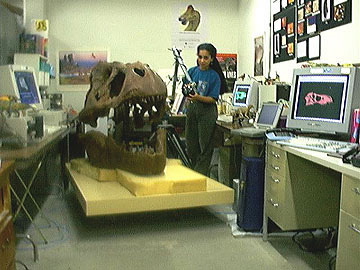
paleontology at the Museum of the Rockies in Montana, and in the summer of 2000 became discoverer of the specimen of Tyrannosaurus rex named after her, C-rex.
Now residing on the Oregon coast, Celeste has been studying Egyptian hieroglyphs, which have provided important keys for deciphering Indus, such as phonetic complements, reading direction, and certain glyphs like 06 house/temple 𓉗. She is fascinated by petroglyphs, and is seeking keys
that unite world languages and cultures.
|