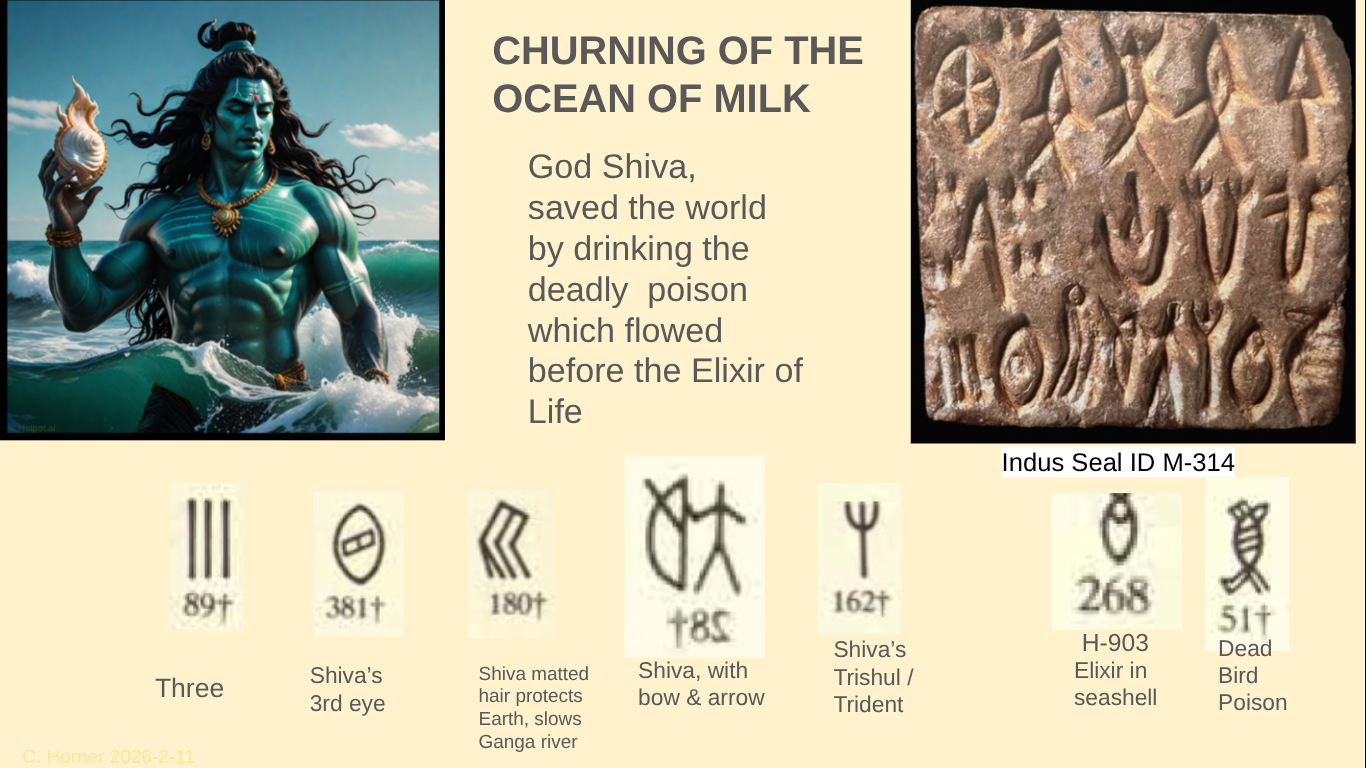
HE INDUS SCRIPT is one of the greatest undeciphered writing systems of the world. In 2024, researcher Celeste Horner made a breathrough discovery that Indus Script glyphs represented famous Hindu myths. She developed an approach to interpretation with the iconography of Hindu mythology. It is proposed that this seal contains symbols connected with the Churning of the Ocean of Milk. In the legend, the gods are desperate. They have lost all of their powers, strength, and wealth because of a curse. To recover, they need resources from the bottom of the ocean. They are forced to work with their arch-rivals the demons. They break Mount Mandara from the peak of Mount Meru and use it to churn the Ocean of Milk to stir up the elixir of immortality from its depths. With the giant serpent Vasuki as a rope, the two parties pulled back and forth. The mountain started to sink, so the god Vishnu appeared in his turtle form Kurma to support it. Next, poison bubbled out, which would have destroyed the world, but the god Shiva drank it. Many treasures came from the sea, such as a wish-fulfilling tree and cow, and Lakshmi, goddess of fortune. The demons tried to steal the gifts but Vishnu seduced them with his beautiful goddess avatar and beheaded another demon which causes eclipses. The icons of this seal recognize Vishnu with the chakra wheel, and Shiva with his trident and moon.
Line 1 begins with an up arrow which means great. It recognizes three gods: Shiva, Vishnu and Lakshmi, each represented by a fish symbol. Shiva's fish has a dot for his third eye, the Vishnu fish has 4 arms, and the goddess fish has a crown or peaked roof as lady of the house. The author cleverly deploys poly-semantics -- a chakra wheel with several meanings: the churning action of the ocean, the distinctive chakra weapon of Vishnu, and the shell of Vishnu's turtle avatar. It can also represent the whole world and its cosmic axis. The goddess symbol, a fish with pointed roof crown refers both to goddess Lakshmi and Vishnu in goddess disguise as Mohini. Line 2 weaves an agricultural metaphor. The farmer's plow turns the earth to promote fertility. In this legend, gods and demons churn the ocean to bring forth a harvest of treasure. On the 3rd line, Shiva, with his signature weapons trishul trident, bow, and destroying third eye, is recognized for saving the world for swallowing the poison which flowed before the elixir of immortality.
The text is divided into three registers. The top is heaven. It starts with an up arrow aiming above. It names gods Shiva, Vishnu, and Lakshmi. It ends with a symbol for heaven, the chakra (wheel). It can also symbolize loca (world), star, and cosmic axis. It is like the 𒀭 cuneiform U+1202D; DINGIR symbol, pronounced "al" god and "an" for heaven. (Check L and A values when symbols used phonetically, though most inscriptions appear ideographic, giving oral story teller latitude of expression). The middle line represents earth, and has a plow 𓌺 (Egyptian mr hoe hieroglyph U6B, pronounced mr, alluding to Amrita) for tilling the land, and a butter churn, representing cows living on land, and earthly food. The bottom line represents the underworld. It begins with a dead bird glyph and is anchored by Shiva who inhabits cremation grounds and covers with ash, representing the dead, and salvation from death as he drank the deadly halahala poison, saving the world.

Glyph 65, goddess, wife. Small fish with peaked roof or pointed coronet crown indicating lady of the house.
Also used to represent Brahma, who carries a parasol.

Vishnu and Lakshmi, goddess of fortune, his counterpart, holding a pot of Amrita.
(also alludes to Vishnu as avatar enchanting goddess form Mohini)
Source: Legend of Vishnu's gatekeepers and 4 Kumaras

The " double tick marks (line 1: 2nd from right, and line 2, right), glyph 99 (extremely frequent use) mean AND, OF, plural or ongoing action like vibration.
A alpha plowing. O omega rotating butter churn. Spoon tongue. Medicine, offering.
Here they are used to write churning (wheel) and plowing
(symbol shared with Egyptian mr hieroglyph 𓌸 U6)
In balanced composition, two eyes suggested: Destroying third eye, and eye looking upward, praying, seeking (Matches arms reaching upward, middle line, Vishnu, upholder) Shiva negation sign on terrestrial plane is ascetisicm, withdrawal from material attachment. Destroying eye may just reveal, give darshan of an irresistable force - bar magnet rotated, transform, attract, fulfil, cosmic ground. Destruction, annihilation is return home, fulfilment, solving equation of inner longing. Solution, no longer hidden, door of God's eye open to come home. (Vishnu projects own antagonists -- gatekeepers. Demon in Vishnu conch)
Mr is resonant with the quest for Amrita, the elixir of immortality.
Egyptian mwt. Sanskrit Mṛtyu (मृत्यु) mrit, death.

Indus glyphs can have a wide breadth of expression, enabling multiple entendre, and various paths of interpretation.
Pictographic authors show cleverness in composition and thinking from complementary. (Observed in ProtoSinaitic as well). -->
[ INDUS INTERPRETATION HOME ]
C. Horner 2026-2-14, 2026-2-13