Summary:
The Indus Valley Civilization is a mysterious lost giant of human achievement. They lovingly made adorable toys * for their children, like terracotta nodding head bulls pulling wheeled carts. They were also amazing ingenious engineers. In 2600 B.C., two millenia before the impressive Aqua Appia aqueduct of Rome, the Indus Valley had cities of up to 50,000 inhabitants with master-planned street drains servicing a public bath and in-house water plumbing. Over a million square kilometers in expanse, it covered an area larger than that of the contemporary pyramid-building Egyptians and the ziggurat-constructing Mesopotamians combined. Yet for centuries, the script remained an undeciphered enigma. No one could read a word of what they wrote. A Rosetta Stone matching the text to a known language had never been found.
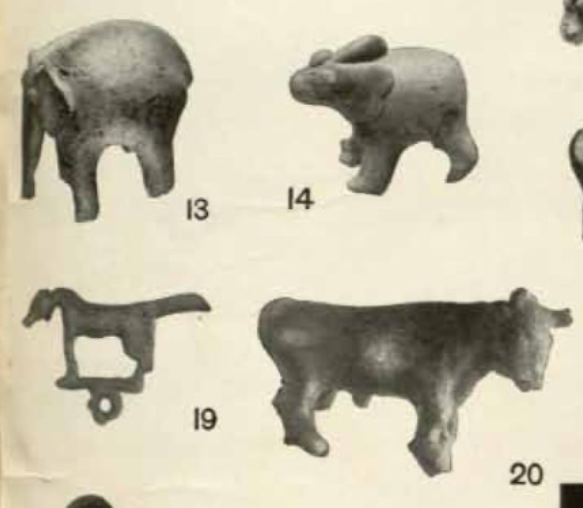
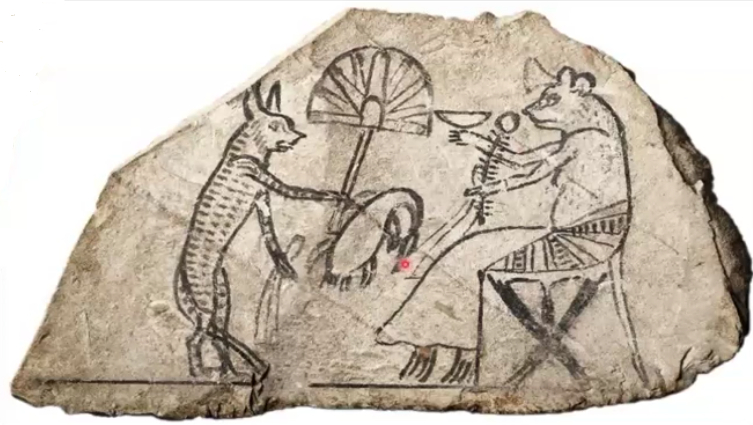
McKay (1937). Further excavations at Mohenjodaro. 2600 B.C: HORSE RIDING CART instead of pulling it, some of world's oldest humor! Children's toys: a rabbit, elephant, bull, and horse riding a cart. The streaming tail, suggests swift motion, in a visual satire, a humorous mundus inversus (reversed-role, world upside-down) form of folk humor. (Not a solid-wheel ox cart, hollow wheel suggests spoke design chariot). This demonstrates early equine awareness, even if rare. This evidence challenges time-lines of when horses and Puranic stories may have been known. The Turin Papyrus and Deir el-Medina ostraca, which show animals doing human activities like chariot driving and playing musical intruments, help demonstrate that ancient artisans had a well-developed genre of visual parody (Mundus Inversus), giving anthropological support to the wheeled equine figurine as a playful inversion. 2026-8-17
Cat serving mouse. Deir el-Medina limestone ostraca. From lecture by Colleen Darnell. Vintage Egyptologist. Fun and games in ancient Egypt
In 2024, however, there was a breakthough. Numerous pictographic seals depicting a man trapped in a tree with by tiger were matched to a legend known in India and Indonesia about a hunter named Lubdaka. Confronted by a hungry-looking tiger, the hunter took refuge in a tree. All night, he prayed to Shiva. Since he accidentally observed ritual on a holy night, Shiva was pleased, and blessed him with safety, and invitation to heaven. This story teaches how important it is to stay up all night, fast, and pray on the holy night of MahaShivratri. This clue made it possible for librarian Celeste Horner to identify the symbol for Shiva. Called the jar sign, it is the U-shaped Shiva tilak forehead mark, and the mark on the hood of a cobras which coil around him. This launched a comprehensive approach to deciphering the Indus script by matching glyphs to the iconography of folklore and wisdom tradition. Many epic legends of Hinduism, passed orally for generations, are archived in the script, such as the Churning of the Ocean of Milk, Jyotirlinga: How Brahma lost his fifth head, and the Curse of the Kumaras.
An astonishing surprise is that the Indus script also records the world's oldest account of the Flood, known from The Torah and Bible Book of Genesis * and the Mesopotamian Epic of Gilgamesh * (Brit Mus tablet | Utnapishtim). In Hinduism, the Flood relates to the Matysa unicorn fish avatar of Vishnu, who saves Manu, first man, from the Deluge. The Garden of Eden including Adam, Eve, and the forbidden apple, is told in the Bhavishya Purana and portrayed on Indus seals in Hindu style with Pashupati, lord of animals. The Tower of Babel destruction is represented, tied to a theme of god Brahma, hubris, and humility. Legends regarding the drying of the Saraswati river, during the 4.2 kilo-year drought event around 2200 B.C., provide a mythological perspective of why the Indus Valley Civilization seemed to disappear due to migration and dispersion.
WHO WAS KING? WHO WAS NOT THE KING? (Sumerian King's List) Chaos in Egypt, Mesopotamia and Indus during 4.2 kilo-year drought event.
This presentation decodes the Indus Script by connecting glyphs to their context in Hindu legend. The statistically most frequent term combinations are interpreted. An automated program for interpreting glyphs and evaluating connection strength between any inscription and the 20 most cited legends has been developed, and is available online.