|
Indus Script deciphered with Hindu mythology
Rosetta Stone discovered with MahaShivratri legend of Lubdhaka: the man, tree, and tiger
by Celeste Claire Horner, 2024
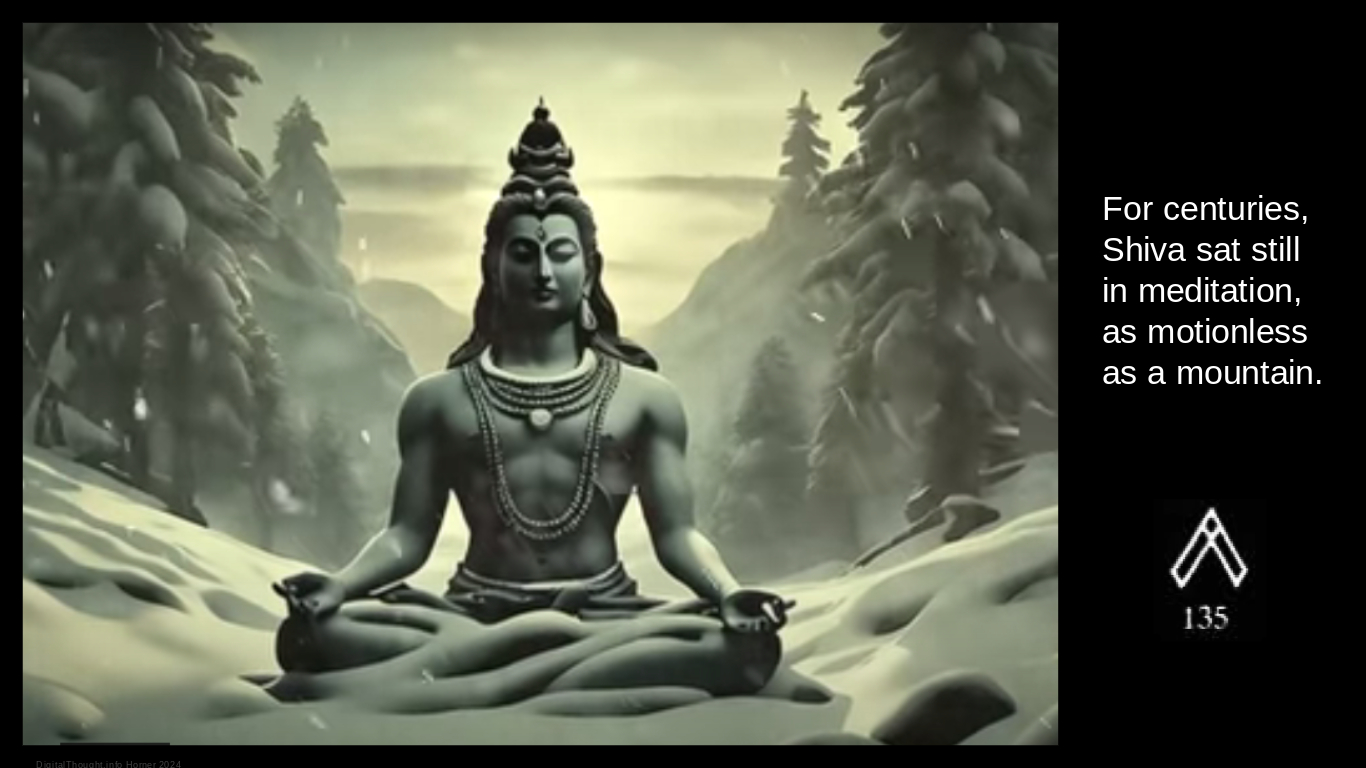
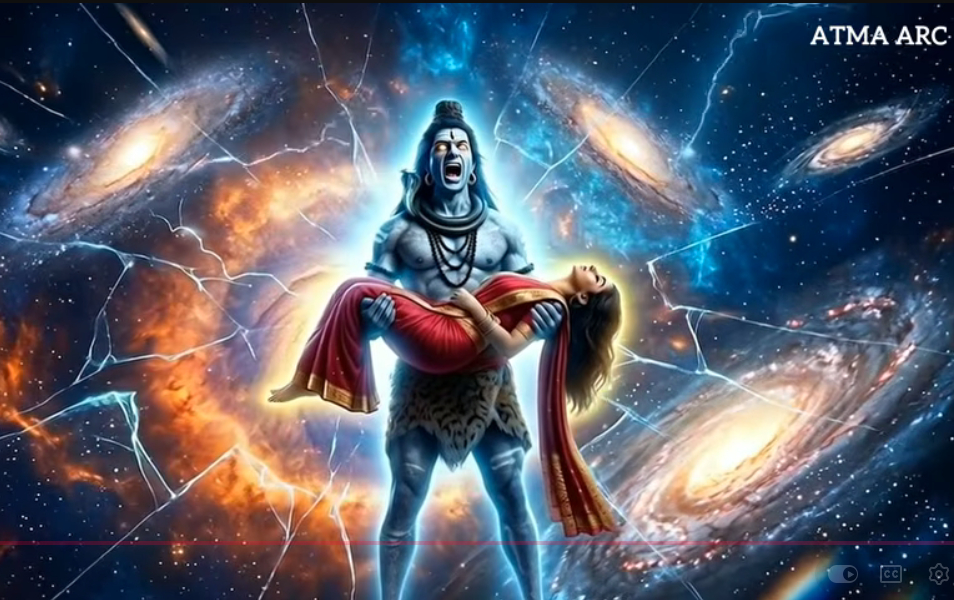
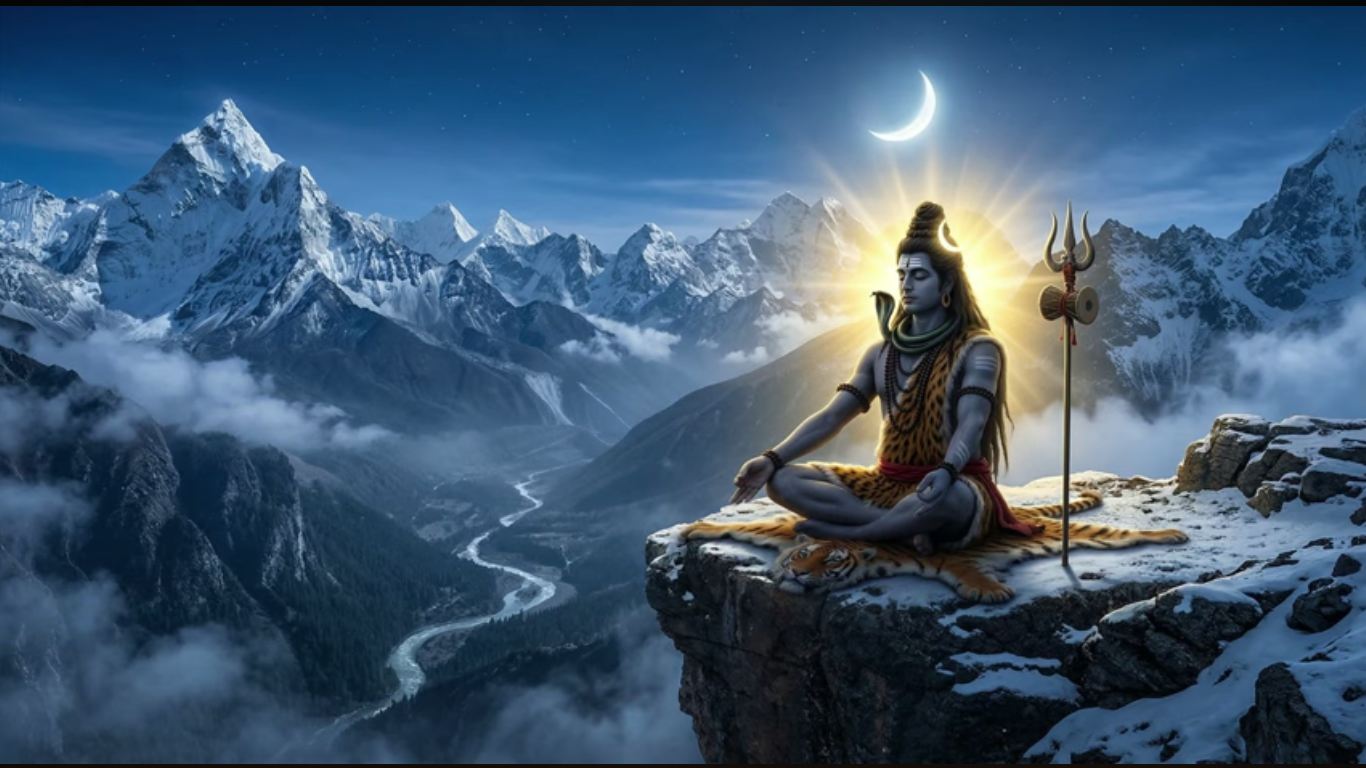
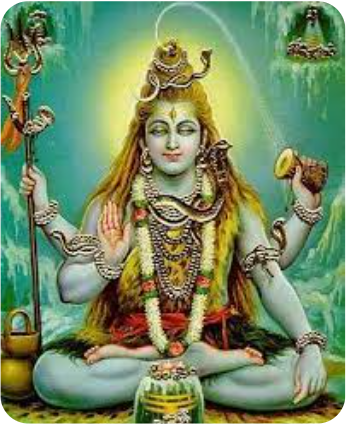
FTER THE TRAGIC DEATH OF HIS WIFE, the god Shiva experienced such great rage and profound depression that he nearly destroyed the universe. Finally, he found his center, restored life to those destroyed during his wrath, and meditated motionless for centuries. Onlookers were curious about the god. They could sense his magnetism, focus, and power. They watched, they sat with him, they came and went. After a long expanse of time, 7 immortal sages, the SaptaRishis, were left by his side. One day, Shiva opened his eyes and started to teach them what he had learned. They became his first disciples, and he became Adiyogi, the first yoga master.
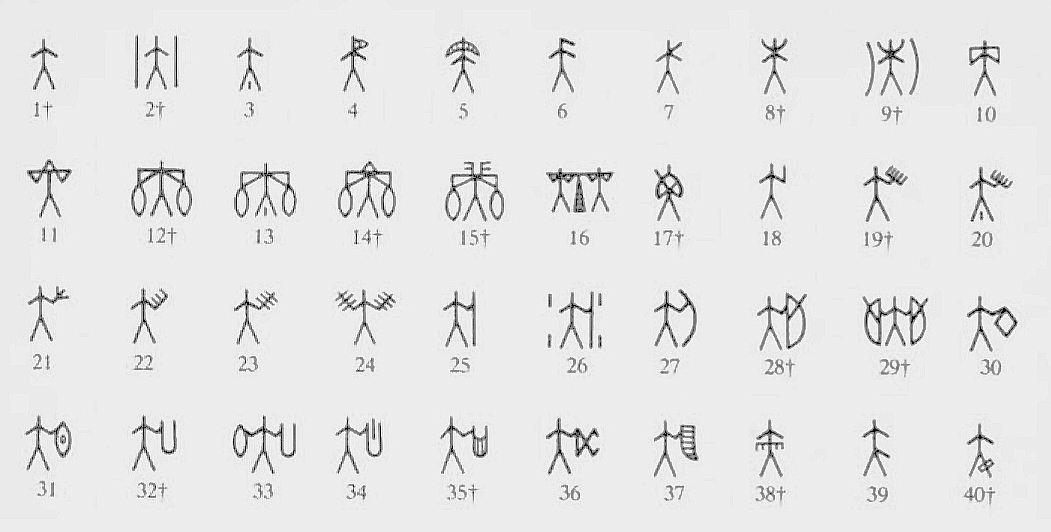
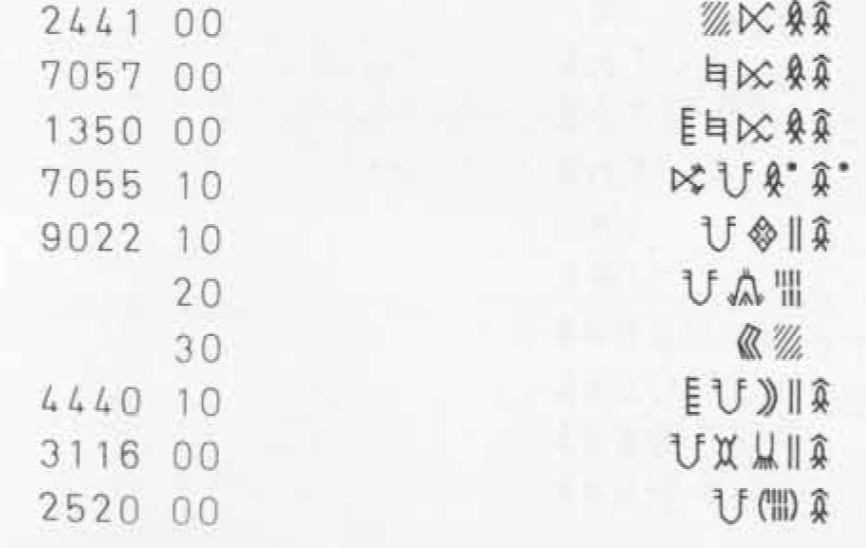
Hindu mythology is a powerful paradigm for interpretation of the Indus writing system. It provides organizational guidance and a coherent explanation for connections between glyphs which have long resisted decipherment.
Shiva and the Seven Sages ^
|
|
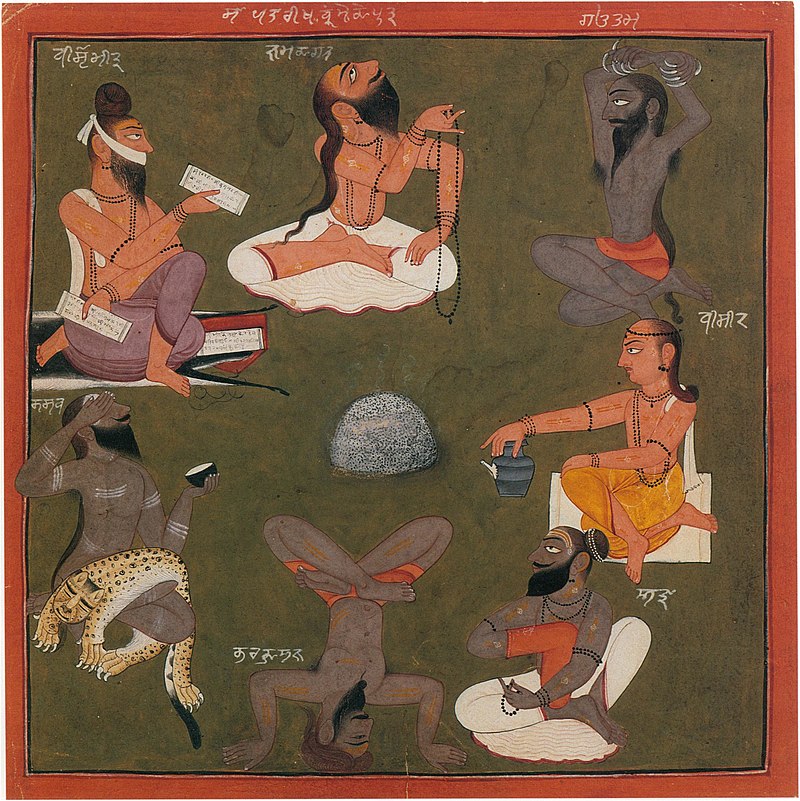
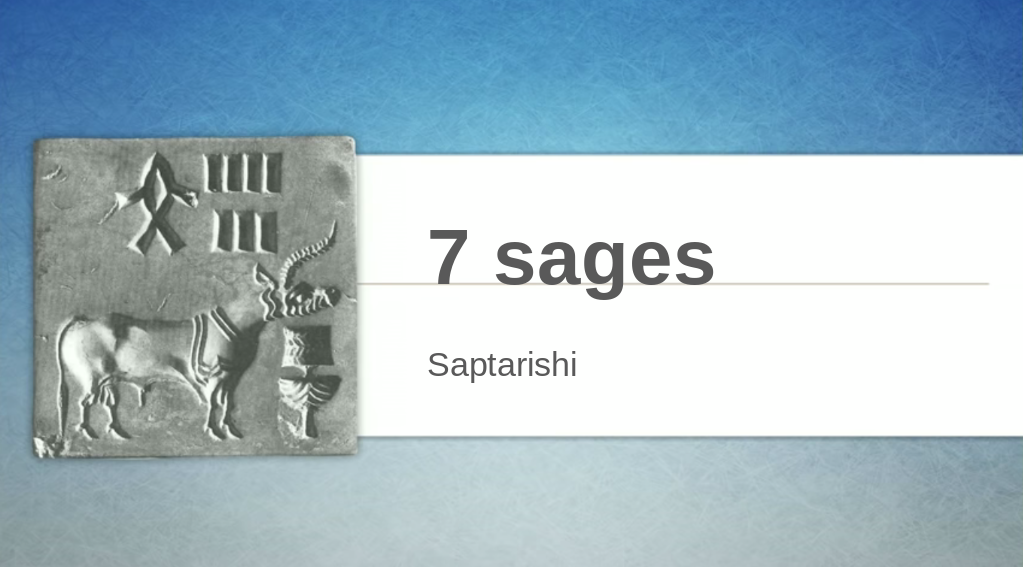
Saptarishi, the Seven Sages. source
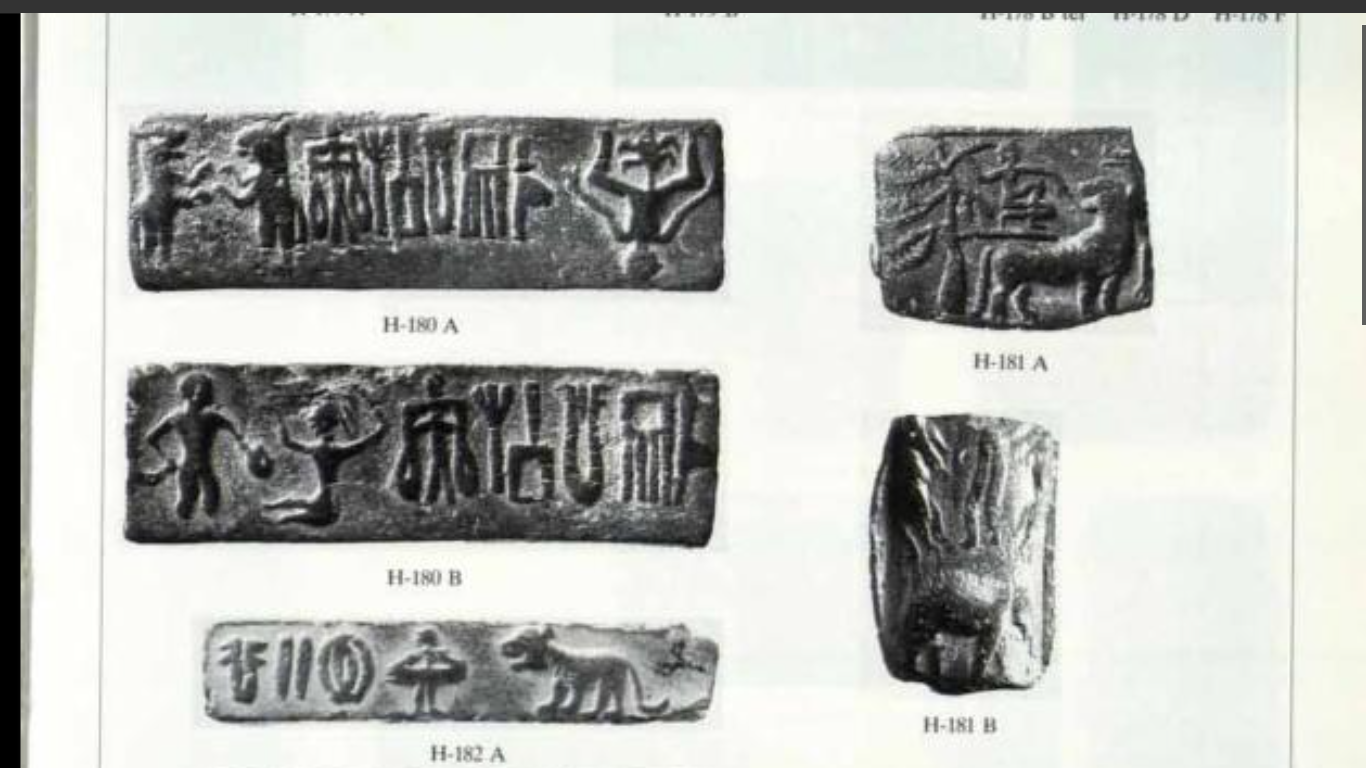
upside down yogi, scorpion, tiger

|
The Seven Sages, the SaptaRishis, are the 7 immortal mind-born sons of Brahma. Hindu cosmology envisons a multi-verse with a Brahma creator god
and seven immortal rishis in each one. They are preserved through catastrophes such as floods which reset the world stage, and seed life and civilization again.
The seven sages learned the art of yoga from Shiva, who personifies the transcendent, unmanifest ultimate deity Brahman.
The seven sages of the current great era of 306,720,000 years (Sanskrit Manvantara) are Atri, Bharadvaja, Gautama Maharishi, Jamadagni, Kashyapa, Vasistha, and Vishvamitra.
They are considered to be alive today. 300 million years ago was the Carboniferous, with insects with 2 foot wingspans. Swamps, coal depositing.
ORIGIN OF LINGA WORSHIP
Once, Shiva, the first guru, performed a hard test of wisdom among his disciples, the Seven Sages. He came into their village naked (Degumbara) and covered with ash. They were shocked and didn't realize that he was illustrating his ultimate nature as the formless one (Alinga). This is one so essential that his only clothes are the cardinal directions of space-time itself. At the same time Shiva, who is usually dishevelled and strange in appearance also possess/es the attribute of being able to appear as the most handsome * and beautiful (compare Ptah beautiful face and Chandra transcendental beauty from yajna and Tara) in the universe.
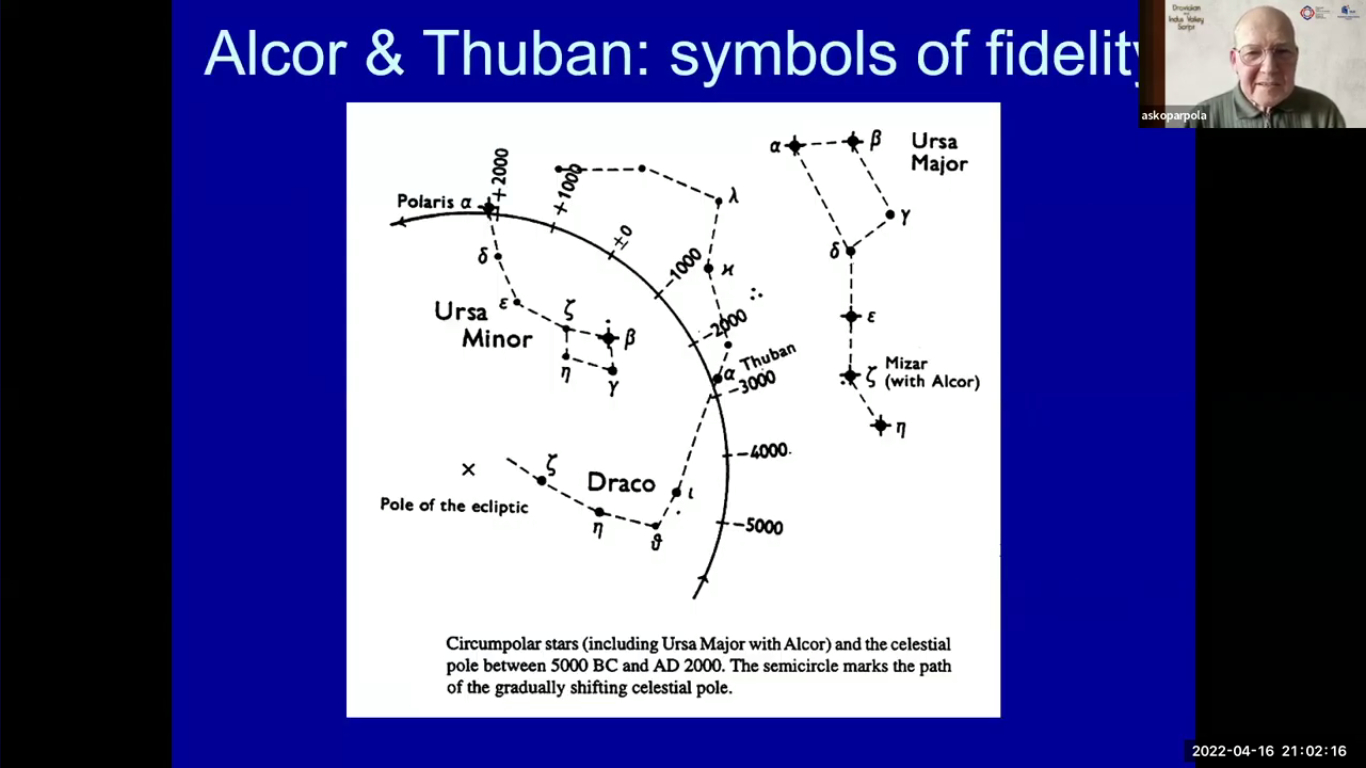
The wives of the sages were seduced by Shiva's magnetism. Only one wife, Arundhati, stayed loyal to her husband Vashishtha. The seven sages are represented by the Ursa Major constellation. The faithful wife is Alcor a faint binary paired with Mizar in Ursa Major. The six wives who fell in love with Shiva are represented by the Pleiades. (Son of Shiva (god of war, Skanda, Murugan) nursed by Krittikas, the Pleiades) The seven sages are the 7 stars of Ursa Major.
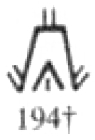
The sages were enraged. With their yogic powers they summoned an enormous raging tiger from their yajna sacrificial fire #194. But Shiva defeated the tiger and its skin became his meditation seat and wrap. Jealous of his power, the sages cursed Shiva so that his phallus fell off. He became Alinga (without a linga phallus) in another sense. When Shiva's masculine virile member hit the ground, it caused a cosmic firestorm #194 that threatened to destroy all three worlds. In a Panic, the Seven Sages implored Shiva's wife Parvati to assume her form as a Yoni womb and enclose and calm the linga. She did this, and from that day the linga and yoni became a perpetually worshipped form. The cross-cultural mythology of gods without a phallus (Alinga also means without gender) applies to Greek Uranus, Egyptian Osiris and Shiva of the Hindu pantheon. Yet Sanskrit gives the key that Alinga is just a visual code for a spirit which is transcendent and formless. *
#56 Vimana | Amrita. Something magical! (Also the negative space from the alchemical standard for feeding unicorn bulls). Vehicle like Nandi #50. Moon boat #293. Gravity of Mace #249. Fly like arrow #28. Rama rode on one #28. Flying carpet #244 tiger skin of energy. Toroid field #403. * Event horizon Face of glory. Chakra and OM conch. * Vimana = flying mountain. V bird wing. i wind. Mn M/\ mountain.M first tier, n top tier point. Expect yajna fire glyph #194, looks like goparam temple gate.
H-180A Vetala meditation penance hanging upside down in tree. Tree in background. Odin also hung upside down to obtain the wisdom of the Runes. Hanging practice of White Bat monk China. Gallows glyph. Tiger skin implies shape-shifter transformation capability. Norse - wing cape and wolf skin. Zeus: swan, bull forms. Here Surya Sun god transforms into horse, Brahma swan, Vishnu boar etc. King Pandu was cursed to die if he attempted sexual intercourse, which occurred after he killed the sage Kindama (who had taken the form of a deer) while he was mating in the forest.
Shiva: Stone Age god. Lord of Animals. Original Man. Vishnu: Bronze Age height, discus, mace. Kings and Heroes. But also primordial waters. Brahma also a god of social order.
Narada Muni wandering sage. * Squirrel upside down. Yggdrasil
Arundhati is the faithful wife of the sage Vashistha in Hindu mythology, embodying devotion, purity, and chastity. She is astronomically identified with the faint star Alcor, which forms a binary system with Mizar (Vashistha) in the Saptarishi constellation (Ursa Major)
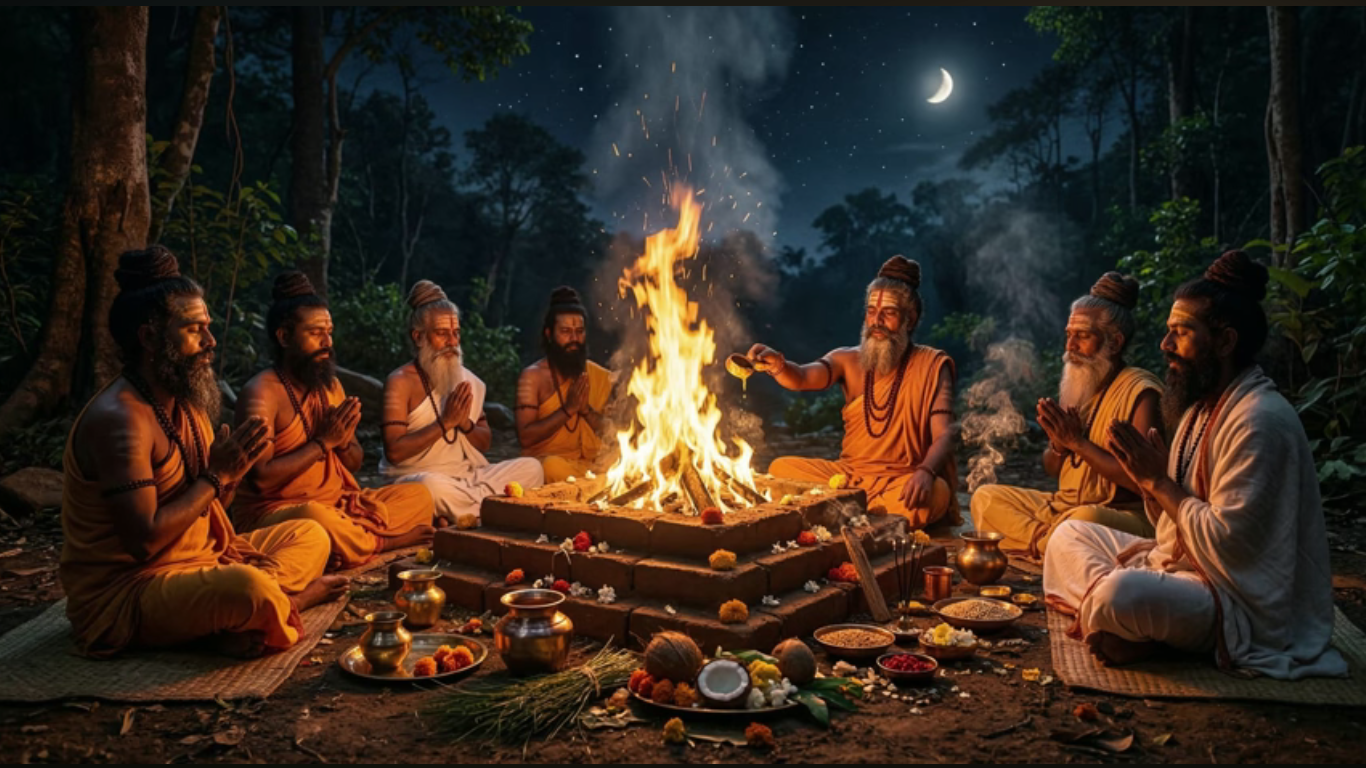
source: Lost Age of the Vedas
|
immortal
mind-born son of Brahma
Hearth, fire, chimney. Square Shiva symbol, upside-down
|
|
Seven Sages wives
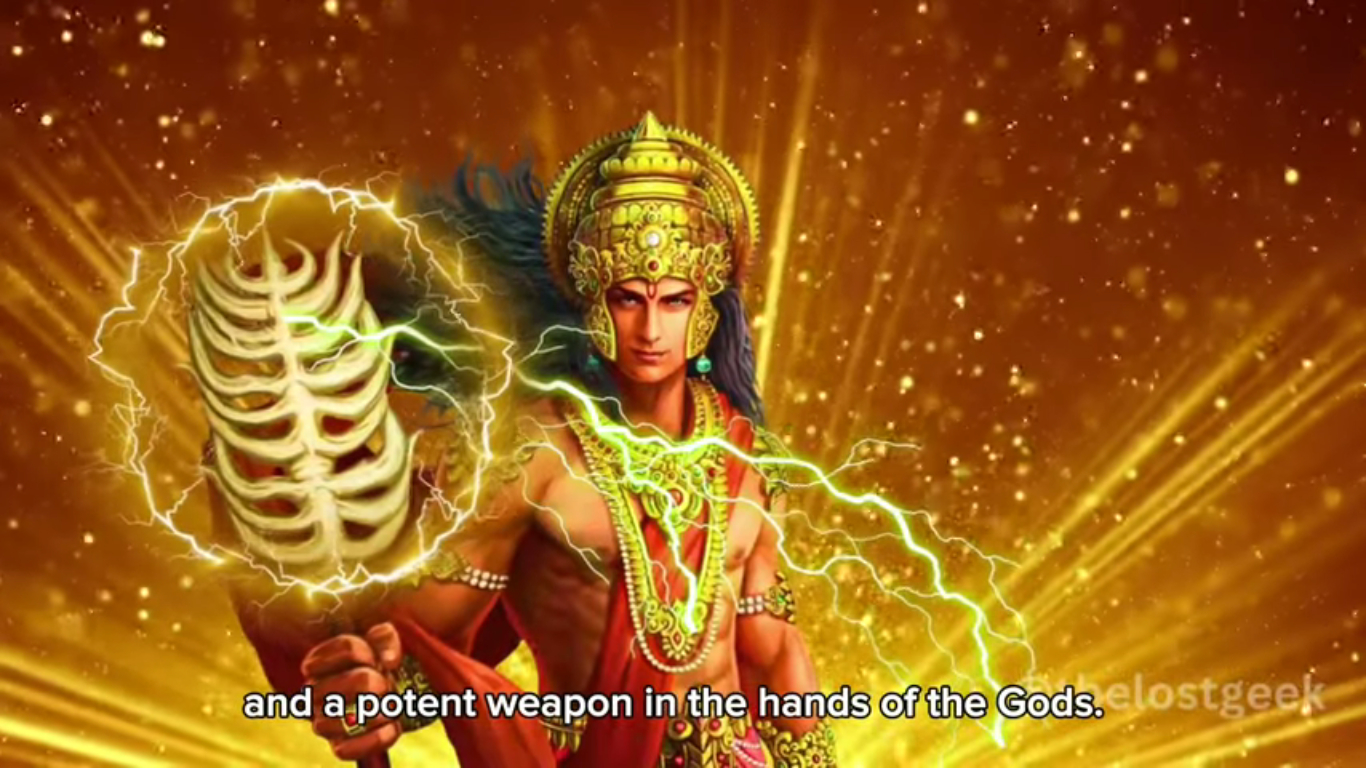
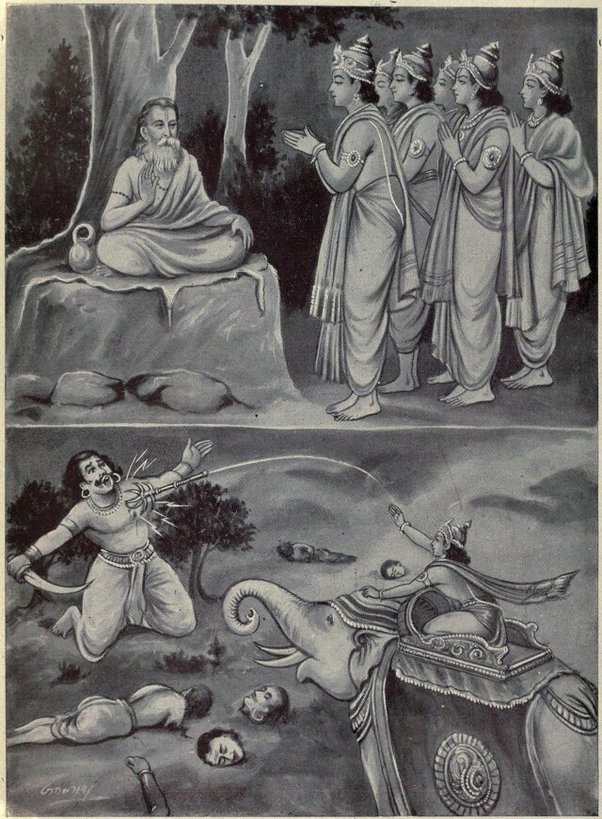
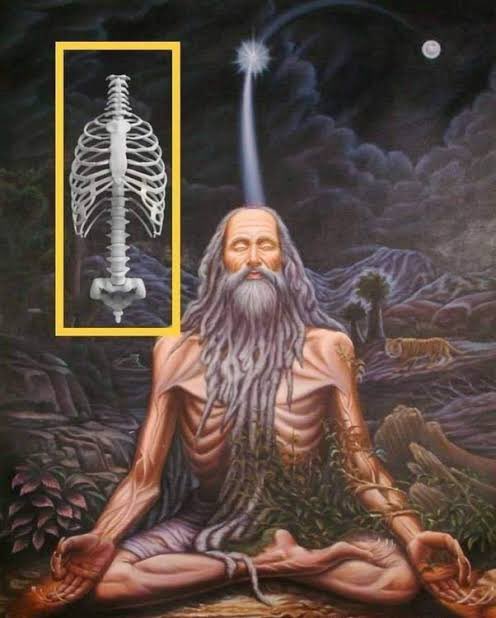
Sage Dadichi gave up his life so that his bones, charged with spiritual energy could be made into a superweapon to defeat an unconquerable demon
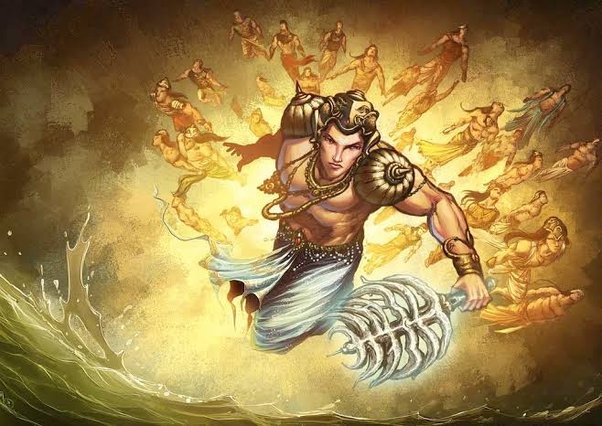
Hindu Saga {God Indra wields the invincible vajra weapon to defeat the demon Vritra who had dried up all the water in the world}
VRITRA, AN INVINCIBLE DEMON*, conquered the world and dried up all the water so that all except those under his command would perish. Desperate,
the gods led by Indra sought the advice of the god Vishnu, preserver of the world. He told them that only a weapon forged from the bones of the world's most
holy saint could defeat the demon. The gods went to the hermitage of sage Dadhichi and humbled themselves. The saint was willing to sacrifice his life. His only
regret is that he would like to see all the holy rivers. With no time to lose, the chief god Indra used his power to divert all the holy rivers through sage
Dadichi's hermitage (Indus glyph #236). Satisfied, the spirit of the sage departed his body. His bones were fashioned into the super-weapons of the gods. The demon was defeated, and the world was saved.
TO DO: Brahmadanda, the ultimate non-weapon, total stillness, Nothing, nullification, wielded by Vasishta defeated all the super-weaspons of Vishwamitra. Pippalada struck Saturn Shanidev, got limp, like Hephaestus. Children exempt from karma. Pippal tree motif. Upside down Shani dev. Buddha Gautama Bodhi tree. Odin. Vetala hang upside down, getting knowledge of future. Ashvatha ... cosmic tree, roots in heaven, branches below. 2026-1-26. Integrate Peepal Project Shivoham. Leaf found on Indus seals, sprouting from head of Pashupati. Connect to leaf and tree glyphs. Upside down: Peter. Hercules facing Ophiuchus. Odin. Cassiopia. King suspended in air when rejected by Indra, powerful sage threatens to remake universe and gods. Threshold gods. Gualao backwards on mule, a hybrid. White bat (upside down) of primordial chaos. Head changing gods: Ganesh, Vishnu horse head, Brahma 5th head. Isis to Hathor. *
( The demi-gods made the mistake of becoming complacent. They were filled with strength because they drank the Amrita from the Ocean of Milk. They defeated their rivals, the demons. Things were going so well, they thought they didn't need any more advice and sent their wise chief advisor away. A double-agent for the demon side took his position. When it was discovered that the double-agent was strengthening the demons, this guru was beheaded. The death provoked the revenge of the king of the demons because the slain advisor was his son. Through severe penance, the demon king gained the boon of another unconquerable demon son who would avenge his brother's death. This was the origin of Vrittra, who conquered the world. The gods were forced to seek the counsel of the advisor they sent away and sacrifice the life of a great and pious sage)
All the sacred rivers were magically diverted through Sage Dadichi's hermitage
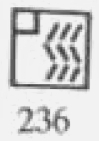
Indus glyph #236. Sacred rivers flow through the hermitage of sage Dadhichi

Inscription bearing glyph #236, a river runs through it.
| Inscription 8301 |
| ▨ |
|
 |
missing
glyph |
riverside
temple |
temple
puram |
2024-6-8 CCH
𓉢
Egyptian hieroglyph 010A for a temple of life

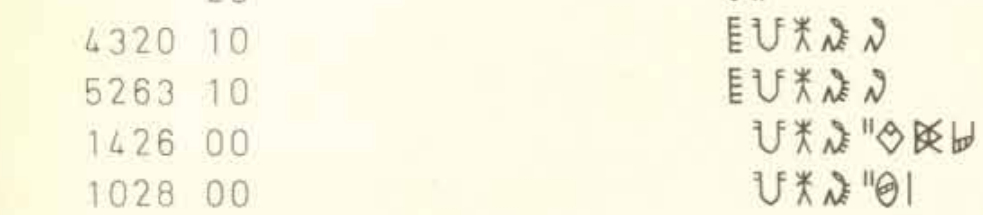
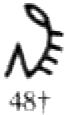
Inscription 2283: Weapon (astra). And. Sage. Backbone (eternal, endless, story). Shiva (destruction)
2584: Backbone. Projectiles. And, plural, multiplied. Shiva 3rd eye of destruction. Asura. Shiva, lord of destruction.
2701. Weapon. Speaking (voice activated). Swallowing, Brahmadanda swallows all weapons. Point shows annihilation of Adversary #216. Asura #53.
Weapons (Astras)
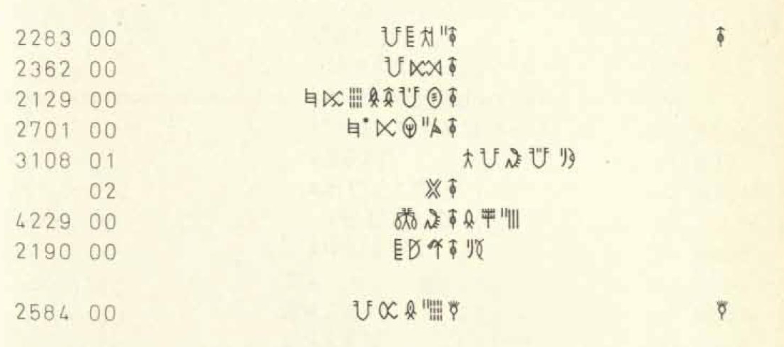
Weapons of Shiva
charged with long years of spiritual austerity, could be made into a superweapon of Indra to defeat an unconquerable demon
His dying wish was to see the holy rivers, so god Indra used his power to instantly divert them all through Dadichi's ashram. (The glyph also represents that
Dadhichi's hermitage was on the banks of the Saraswati River). (Indus Valley grand temples not found because religion was based on perishable meditation shelters and
yoga practice along river banks. Stations of spiritual progress like later along the Nile.)

Sacred rivers flowing through Dadichi ashram / hermitage / * puram
Tirtha. Sacred crossing place.


@
Lost Geek: Vajra | @
|
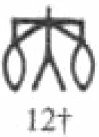
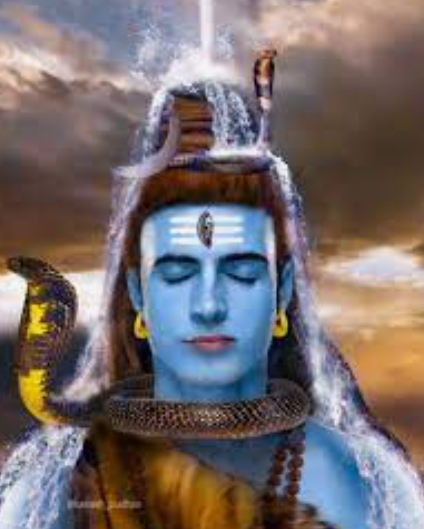
Shiva, the Water-Bearer
|
Shiva is the water bearer because
he breaks the fall
of the Ganges River
from Heaven. It springs up
from his top-knot. Shiva is also a
water-bearer> because he made
it possible for the Elixir of Life,
Amrita to be made because
he swallowed the poison
which accompanied it.
|
According to Hindu legend, the world was once threatened by demons who hid under the ocean. They would emerge at night and slaughter holy sages.
In response, the great sage Agastia drank the ocean so that the lair of the demons was revealed and the gods, led by Indra destroyed them. The world
remained with extremely low water levels for generations. Then, a righteous king Sage Bhagiratha performed great acts to bring the Ganga river from Heaven to Earth.
In doing so, the holy waters released 60,000 souls of his ancestors (sons of king Sagara) who were suffering in the after-life for their misdeeds, and restored the seas of Earth. The water descended
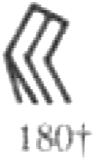
with such great force, that Shiva intervened to let the water fall on his head, and then flow (#180) more gently out from his matted locks of hair (#181 with crescent moon). This is
one reason why Shiva is considered a water-bearer and axis of balance in the universe.
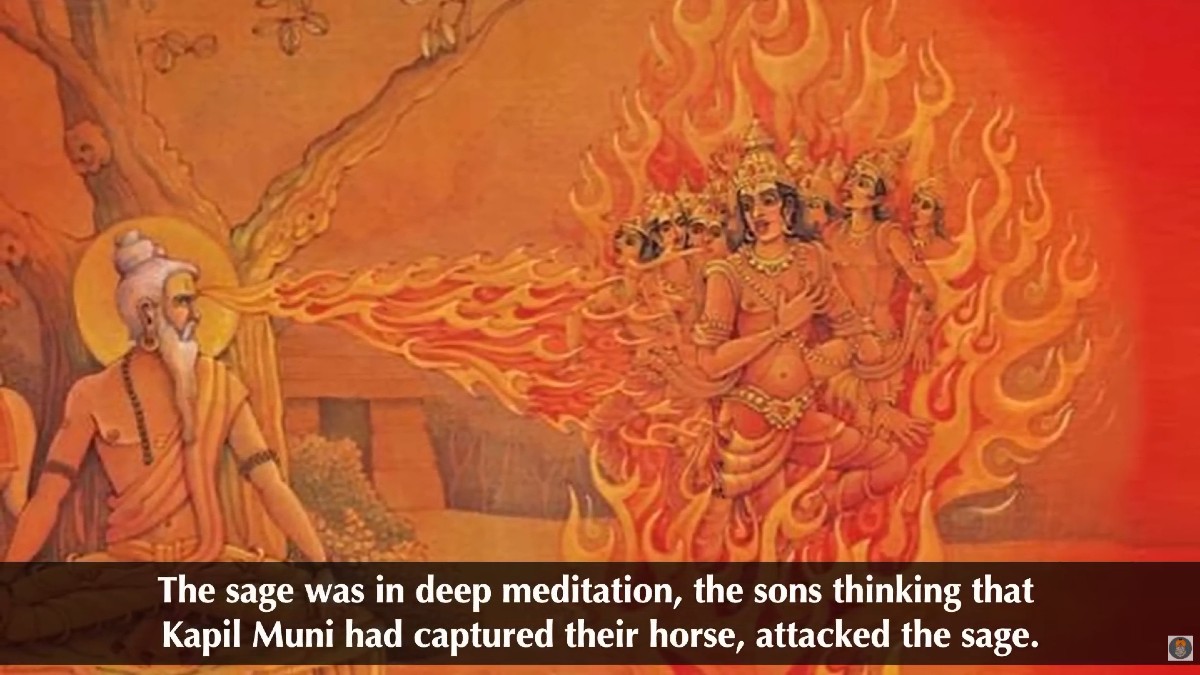
King Sagara performed a ceremony in which a sanctified horse is allowed to run free. The horse went missing, so the 60,000
sons went to look for it. They found it at the hermitage of sage Kapila. He was deep in meditation, but his trance was broken by
the disruption of the 60,000 sons who falsely accused him of stealing the horse. Enraged by the disturbance, Sage Kapila Muni burnt the 60,000 sons to ash with his 3rd eye.
Hindu Saga
For generations, the spirits of the 60,000 sons of Sagara wandered the afterlife as lost souls. Finally, their righteous descendant Bhaghiratha accumulated enough spiritual merit to liberate them. He was able to petition the the holy Ganga river down from heaven to wash their ashes. By this, the 60,000 sons of Sagara were released and entered paradise.
The Ganga river comes from outside the universe. When Vishnu expended his dwarf form to cosmic size to defeat Bali, his toe cracked the cosmic egg and let in the causal ocean waters. These remained in heaven in the kamandalu of Brahma until Bhaghiratha was rewarded by the descent of Ganga. Shiva bears the force of the falling waters on his head, absorbing the shock with his labyrinthine locks of hair.
(Alchemy standard. Moon is a goblet, the chalice, the Holy Grail that collects the cosmic waters of life, causing the Moon to wax and grow. In the Waning phase, the gods are drinking the soma, each in their appointed hour, according to legend. Divine animals have a manger with both drink and food, or perhaps drink and the filter used to pressed the mushroom cap, moon symbol? Prana is inward absorption? of this limitless energy. (Energy in, upana, circular ccw cw etc) 2026-6-23 CCH)
|
CONTINUE TO DRAFT PAGE 2 | BACK TO INDUS DECIPHERMENT HOME PAGE
DRAFT UPDATED 2024-6-8. DRAFT 2024-5-29 Celeste Claire Horner 2024-4 | celeste.horner@gmail.com | celeste@digitalthought.info
DigitalThought.info: Hidden Symbols in the Alphabet
|
| | |
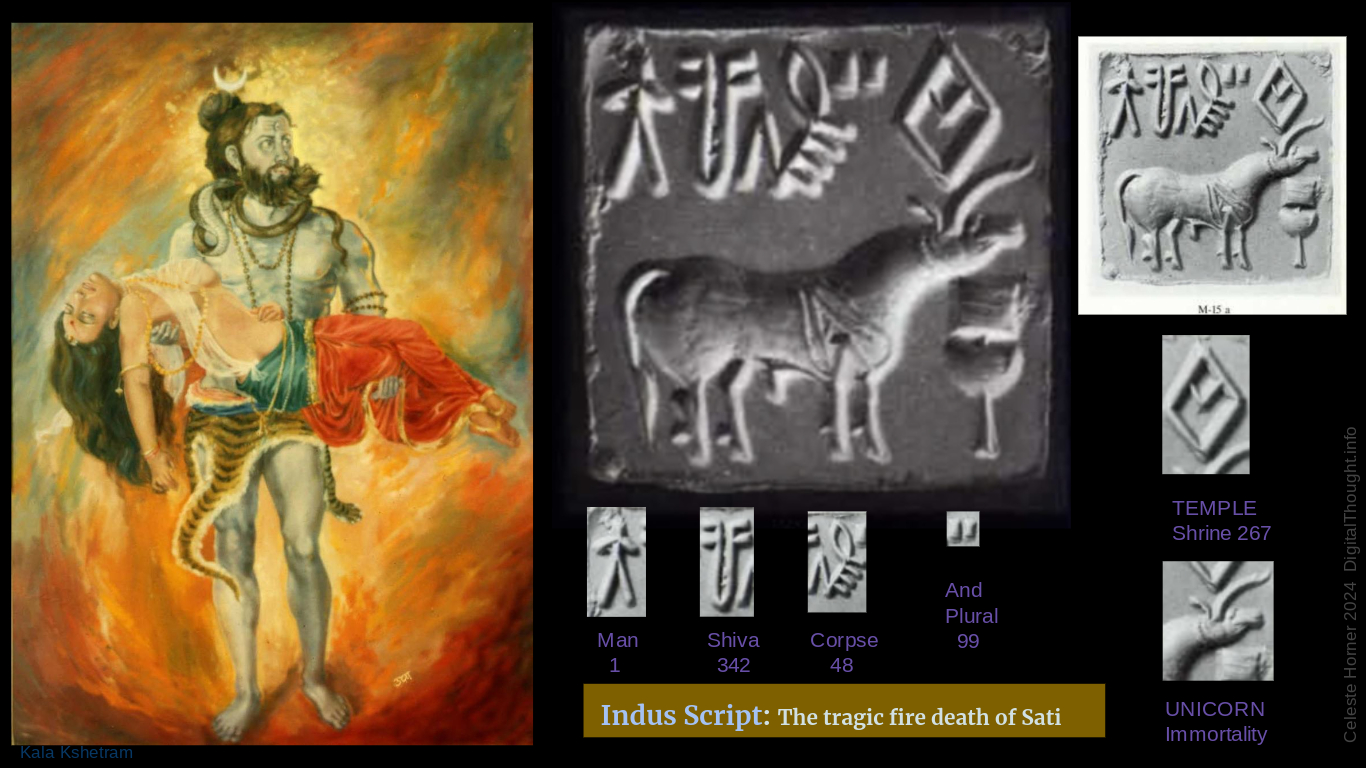
 Shiva - Sati corpse - Daksha's yajna fire - # - Churning of the Ocean of Milk - Mount Meru, Mount Mandara - Binding of Blue throat of Shiva after swallowing halahala poison