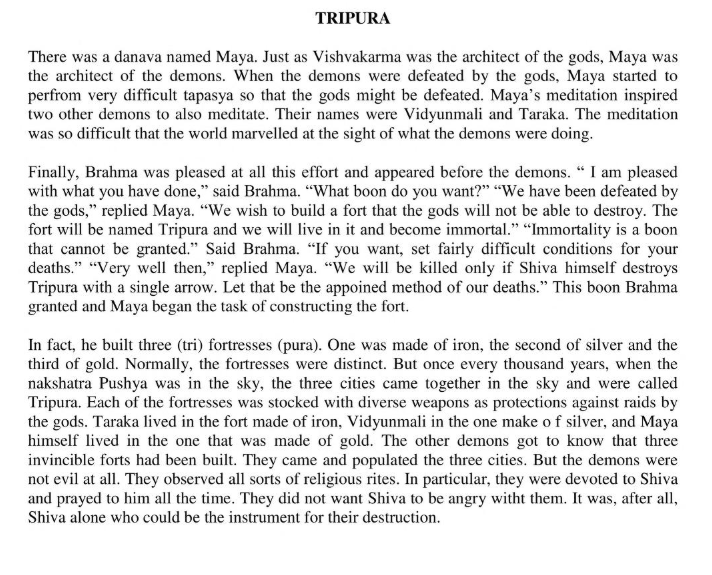
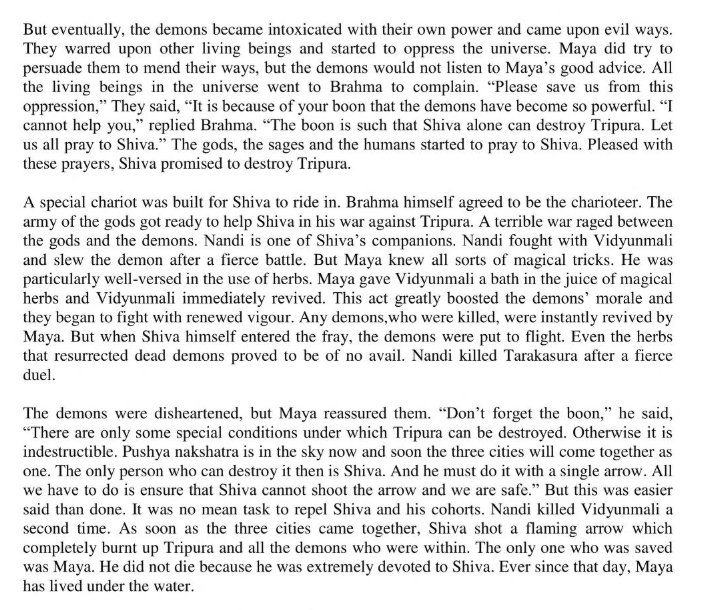
LEGEND OF TRIPURA
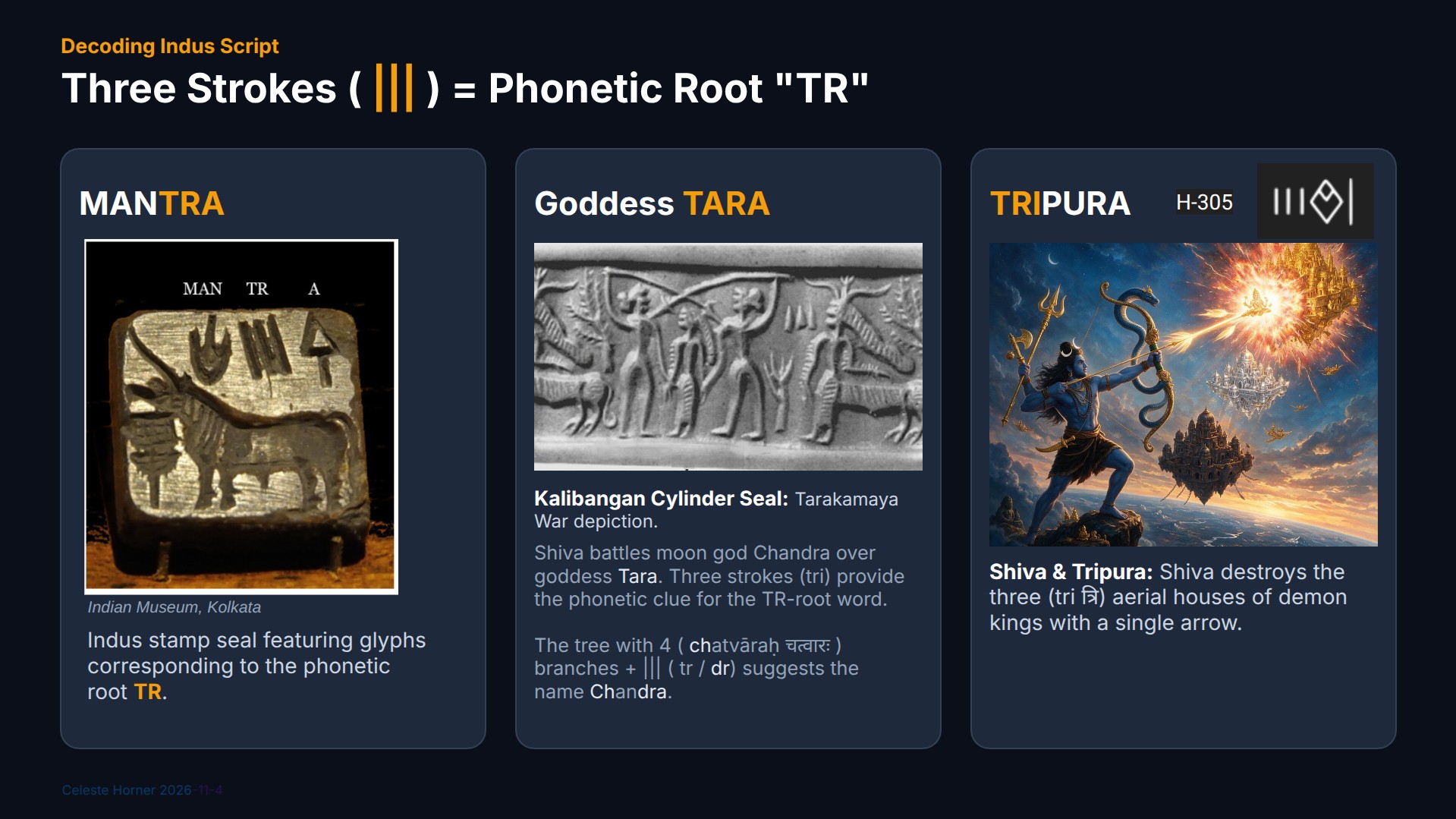
THREE DEMON HOUSES in the sky: iron, silver, and gold
Shiva destroys the three floating cities of the demons with a single arrow
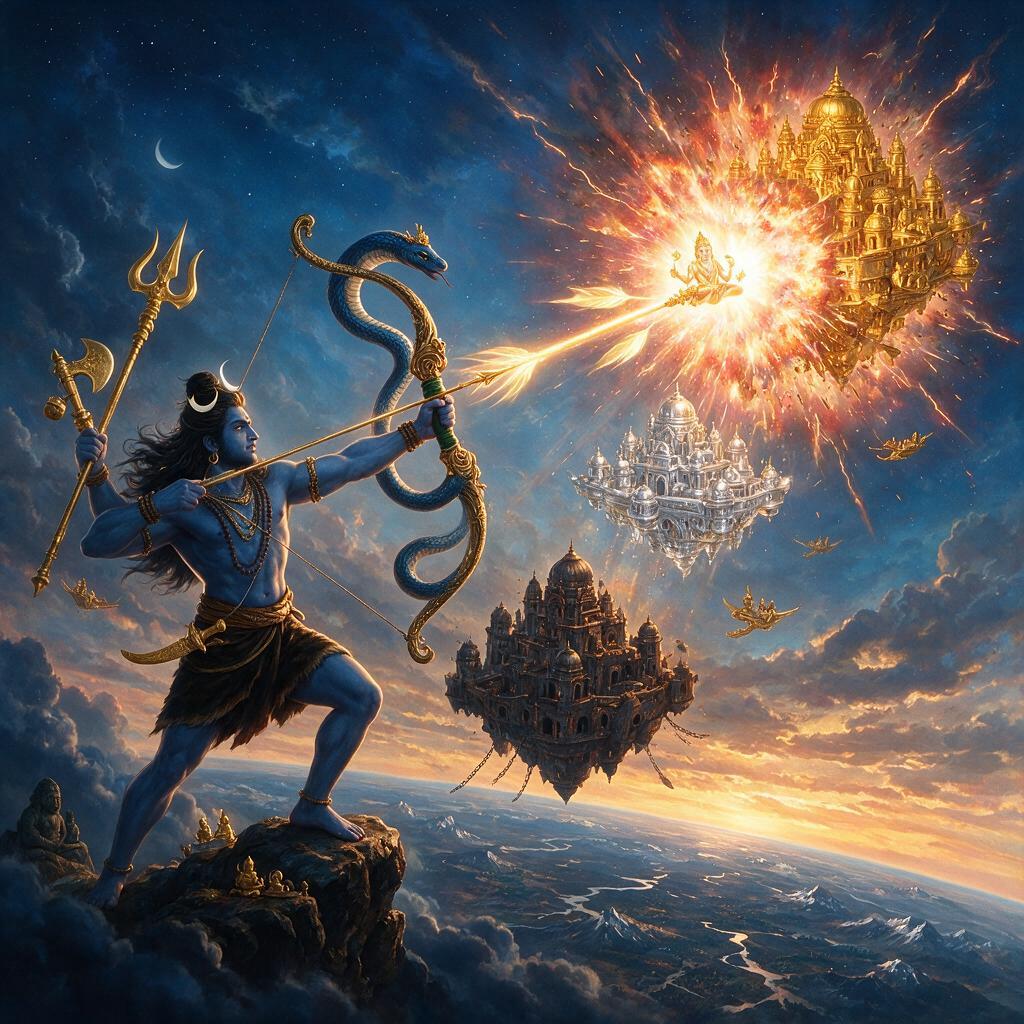
C. Horner 2026-10-11 via pixlr AI
|
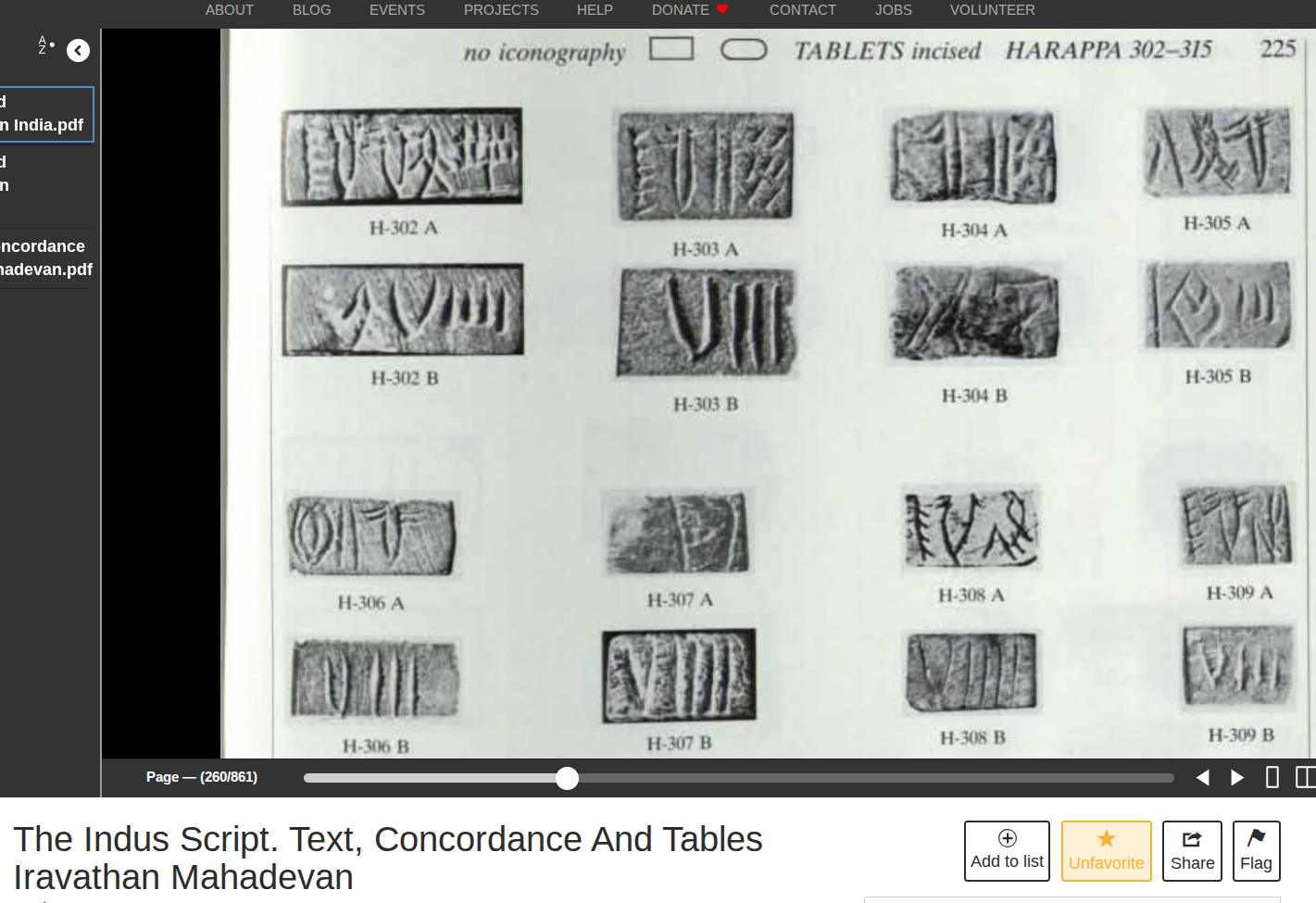
Glyph Tripura: Mahadevan 1977 concordance entries
[1] Demon city of Tripura
[2] Aerial cities of demons destroyed by Shiva when they aligned into single arrow target, only way to defeat magical defense
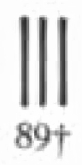
[3] ||| 3 unified into one
[4] Light
[5]
[6]
[7]
[8]
[9]
|
All 18 Major Puranas
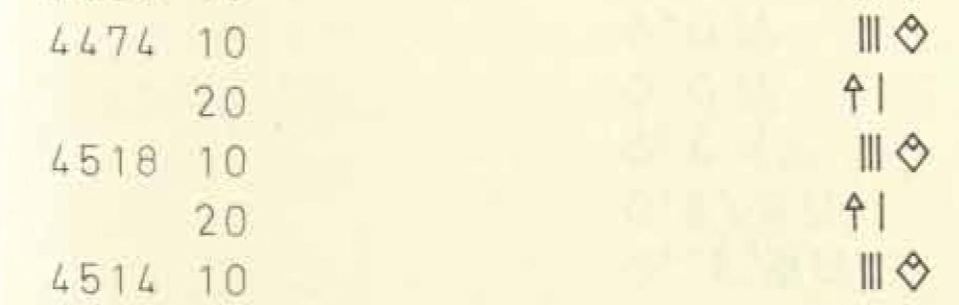
Mahadevan 1977 Concordance. Triple house. Single arrow
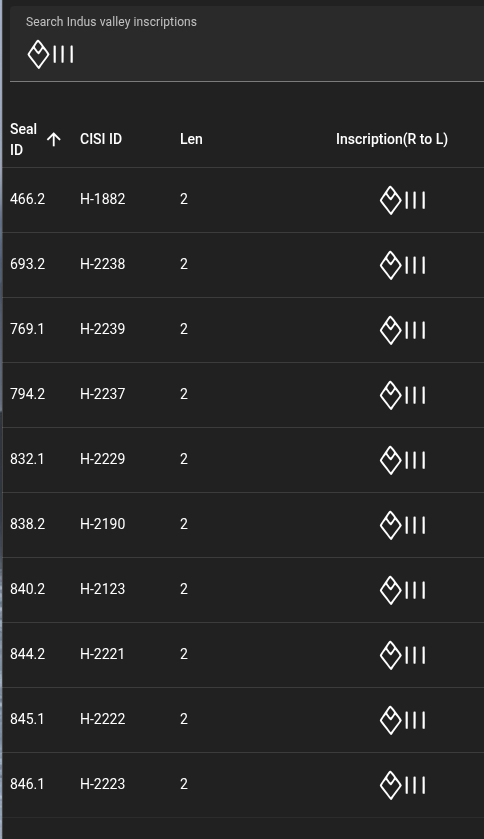
Indusscript.net
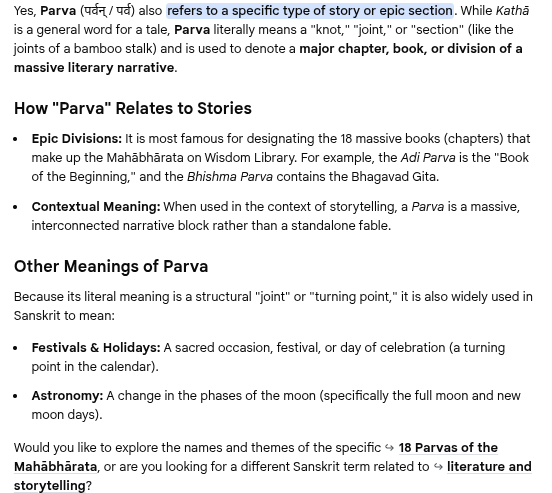
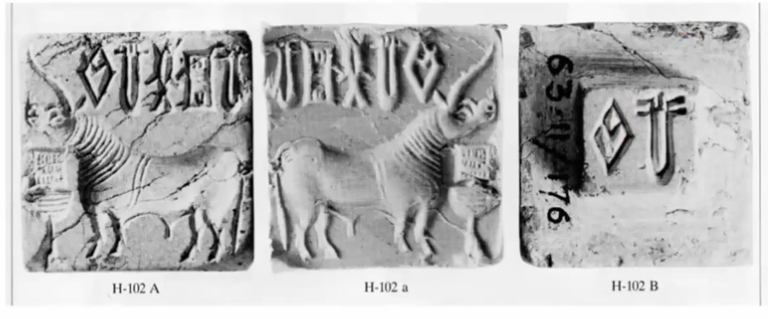
Jyotirlinga temple. Temple of Shiva lingam
(( How to write Puabi Queen.: P pr house. 3 stroke =U= #345 wa. Tiger mat #244 B. single stroke =U= I #343. Tiger mat opposition Eclipse? ))
TEMPLE OF SATI AND SHIVA
Shakti Peethas (where parts of the Goddess Sati's body fell)
 |
|
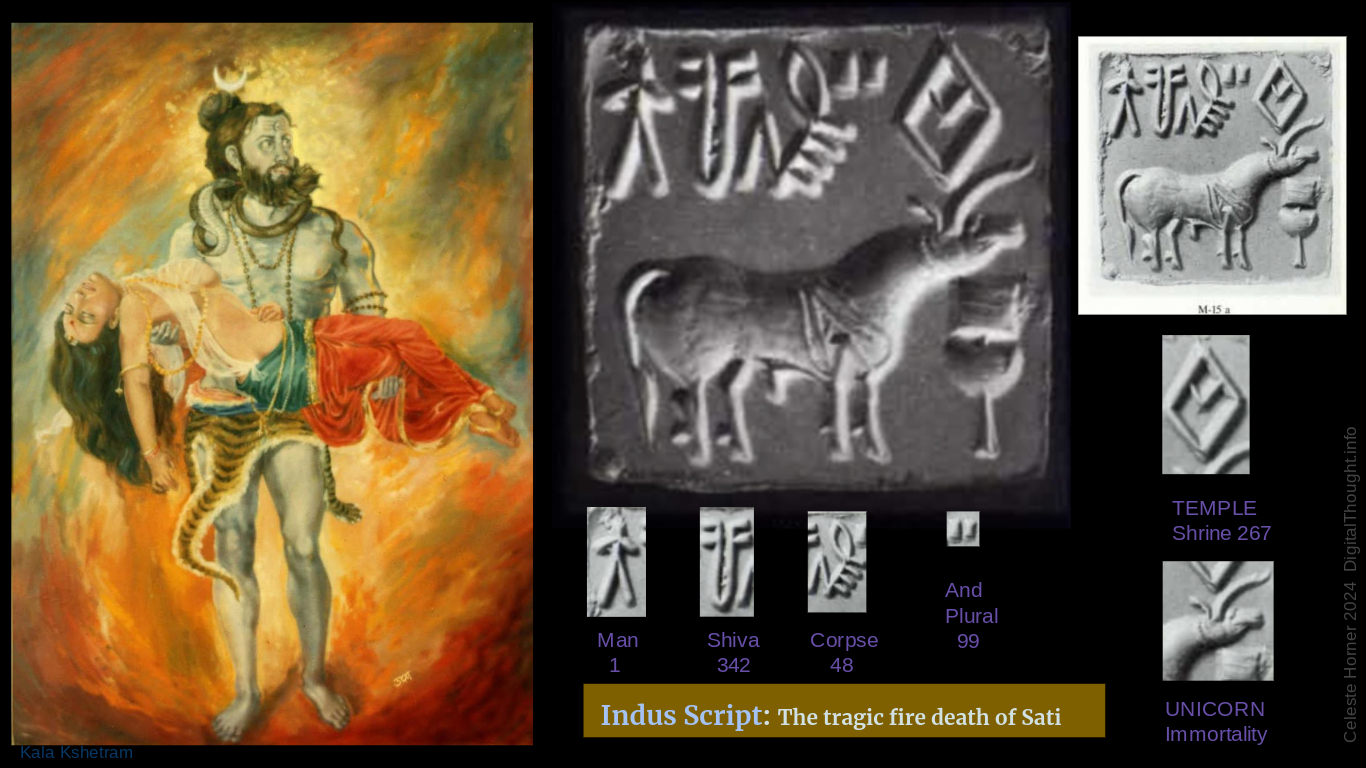
Figure 1. Indus Script glyphs deciphered by Celeste Horner 2024. Shiva art by Kala Kshetram @Tumbler
Indus Seal M-15 refers to the Hindu shrines dedicated to Sati, the first wife of the god Shiva. She sacrificed herself in fire because her father, a king, disrespected her husband. Indus Script glyph #48 depicts a corpse, with vertebral spines protruding from the back. In this story, these strokes also suggest robes, funeral wrapping, and flames. Glyph #48 also appears Ardhanishwara legend of the three-legged skeleton man, to describe Shiva as a god of the dead, and to represent the noose, called pashu with which the death god Yam extracts souls from their bodies at the end of life. The name of Shiva as Pashupati, Lord of Animals, may be written with glyph #48.
Indus Script glyph #48. SATI DIED TRAGICALLY. She married Shiva, God of Destruction against the wishes of her father, a king. He did not want his beautiful princess daughter to marry a poor, matted-hair ascetic who was covered with crematorium ash and writhing snakes. To show his contempt, the king hosted an elaborate sacrificial banquet and invited all the gods of the universe, except Shiva. Sati went to the event, dispite not being invited. When she appeared, her own father mocked her husband, and humiliated her. In protest, unwaveringly loyal to her husband Shiva, Sati walked into the sacrificial fire and died.
Shiva arrived in a consuming rage and destroyed the entire place. After that, he staggered around the land like a mindless drunken man, agonizing in bottomless grief, carrying the body of his dead wife. He was oblivious that parts of her corpse fell to the ground. His trail of tears became a pilgrimmage route in India to this day. Each part of Sati's body that fell has a Shakti peeta shrine and letter of the Sanskrit alphabet dedicated it, so that her memory will never die. Finally Shiva's grief gave way to anger, and he started the fatal steps of his Tandava dance that had the power to destroy the universe. At that point, Vishnu, the God of Preservation intervened. He attacked Shiva with his whirling sawtooth Sudarshan chakra, one of the ultimate weapons of the gods. It vaporized the remaining crumbs of Sati's corpse, and knocked the destructive winds out of Shiva. His mind restored, Shiva walked into a forest, sat down, and meditated motionless -- for centuries.
In Hindu traditions, shrines related to the name Sati generally fall into two distinct historical and theological categories: the ancient, canonical Shakti Peethas (where parts of the Goddess Sati's body fell) and the medieval/regional Sati Mata Temples (mostly in Rajasthan, honoring human widows who committed self-immolation). [1, 2, 3]
🏛️ The Ancient Shakti Peethas (Divine Shrines of Goddess Sati)
According to Vedic mythology, when Goddess Sati sacrificed herself, Lord Shiva carried her body across the universe. To calm Shiva, Lord Vishnu used his Sudarshana Chakra to disintegrate her body into 51 fragments. Wherever a piece fell, a holy shrine or Shakti Peetha was established. [1, 2]

Kamakhya Temple
Closed · Guwahati, Assam, India
Located in Guwahati, Assam. It marks where the Yoni (womb/genitals) of Goddess Sati fell. It is widely recognized as the most powerful and holiest Tantric center of divine feminine energy.

Kalighat Kali Temple
4.4(62.4K)
Hindu temple
Open · Kolkata, West Bengal, India
Situated in Kolkata, West Bengal. This prominent shrine stands where the right toe of Goddess Sati fell.

Jwalamukhi Temple
4.8(29.7K)
Hindu temple
Open · Jawalamukhi, Himachal Pradesh, India
Located in the Kangra Valley of Himachal Pradesh. This temple marks the site where Sati's tongue fell. Uniquely, the goddess is worshipped here as an eternal, naturally burning blue flame emerging from the rocks instead of an idol.

Vishalakshi Temple
4.8(1.5K)
Hindu temple
Open · Varanasi, Domari, Uttar Pradesh, India
Situated at Mir Ghat along the Ganges river in Varanasi, Uttar Pradesh. It marks the location where Goddess Sati's earrings (Kundala) fell.

Maa Bimala Temple
4.7(779)
Hindu temple
Puri, Odisha, India
Located inside the sacred precincts of the Jagannath Temple in Puri, Odisha. It is considered one of the primordial Adi Shakti Peethas where Sati's navel fell. [1, 2, 3, 4, 5, 6, 7, 8, 9, 10]
🧱 Regional Sati Mata Temples (Commemorative Shrines)
In a completely different context, several historic temples in northwestern India (primarily Rajasthan) were built by communities to venerate historical women who practiced sati (immolating themselves on their husband's funeral pyre). The most prominent concentrations are in the Shekhawati region. [1, 2, 3]

Shree Rani Satiji Mandir
4.8(18.1K)
Hindu temple
Open · Jhunjhunu, Rajasthan, India
Located in Jhunjhunu, Rajasthan, this is the largest temple in India dedicated to Rani Sati (Narayani Devi, affectionately called Dadiji). Built entirely of white marble to resemble a grand palace, the main sanctum houses no anthropomorphic idol. Instead, a sacred Trident (Trishul) representing Shakti is worshipped.

Shree Khemi Sati Temple
4.8(417)
Hindu temple
Open · Jhunjhunu, Rajasthan, India
Also located in Jhunjhunu, this is another heavily visited, well-managed historical memorial temple complex revered by the local Marwari and Agrawal community. [1, 2, 3, 4, 5]
|
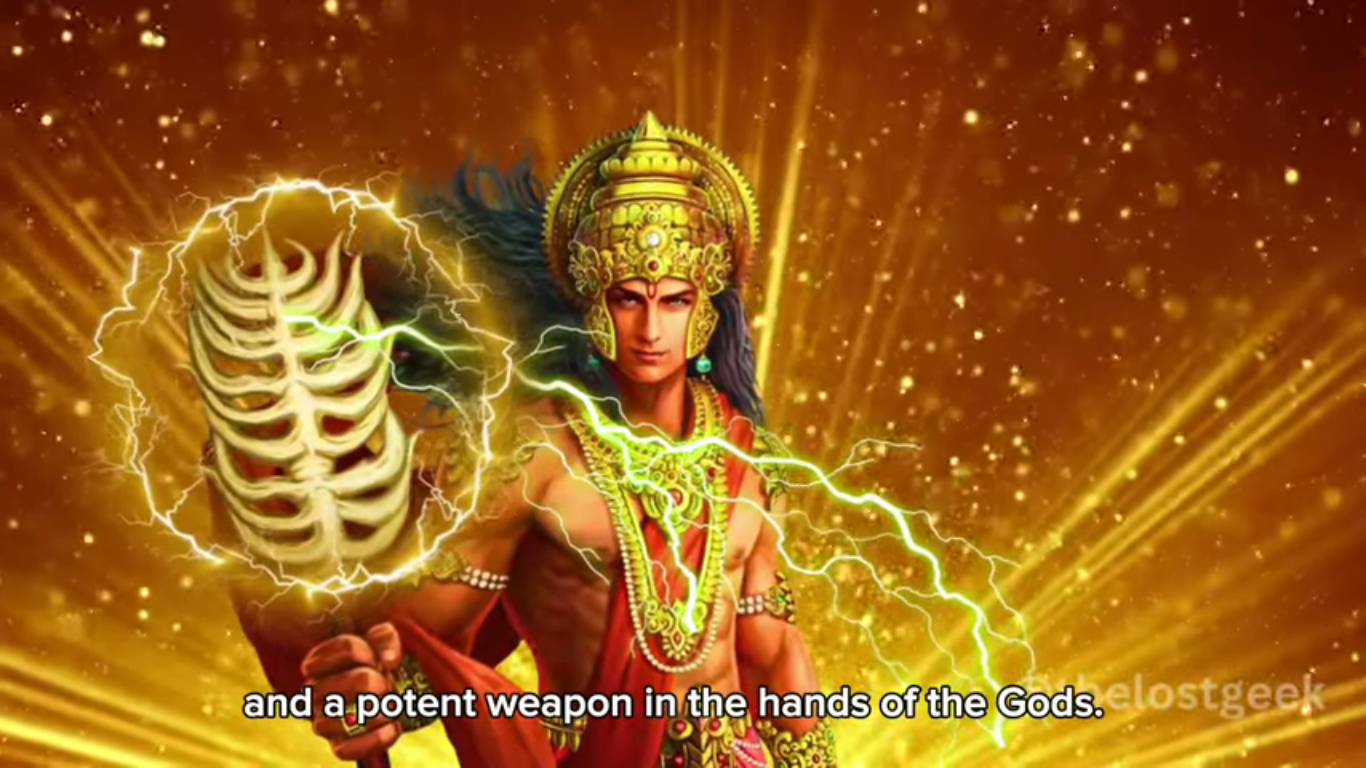
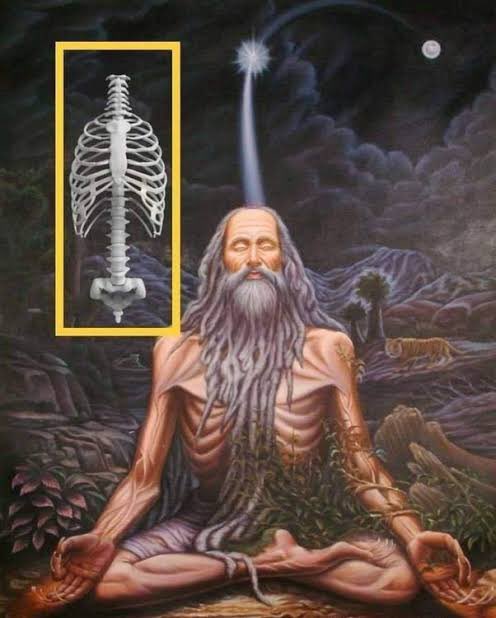

House of rivers. Sage Dadichii requests to see the sacred rivers before giving up his life, sacrificing
his spine to make the invincible vajra weapon. Gods divert sacred riverse through his hermitage so he can see them.
Climate change story. Drying of Saraswati, diversion of Yamuna.
Metaphor - Human house of rivers. Shiva house through which Ganga flows
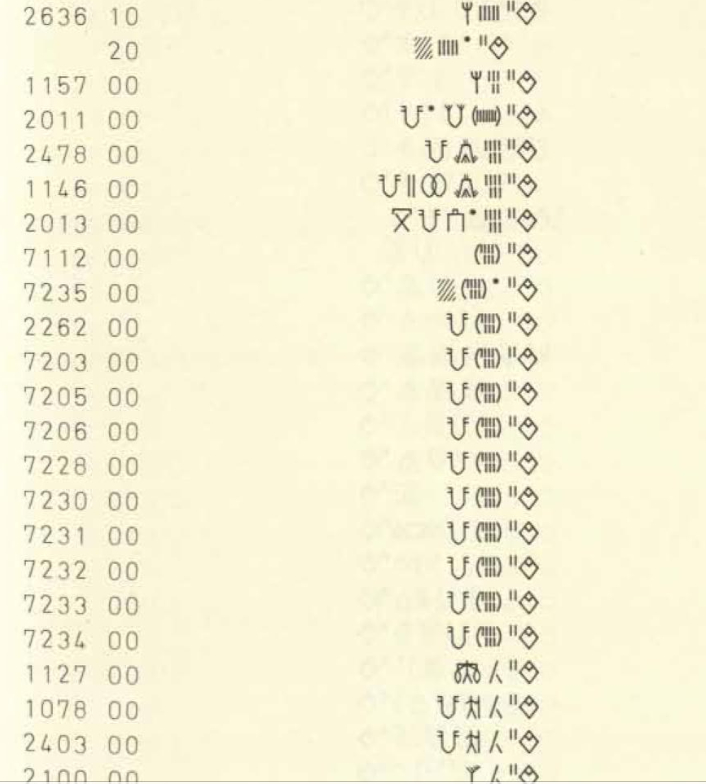
7 Sages ashram (house) with Shiva as adiguru (first guru)
Parva holiday, 7th day of month, dedicated to Shiva
7 gates / chakras
Inscription 1146: 7 mind-born sons of Brahma, the seven sages. Their fire sacrifice tiger attacked Shiva, he wears skin of conquered negative energy, or uses it as his meditation seat
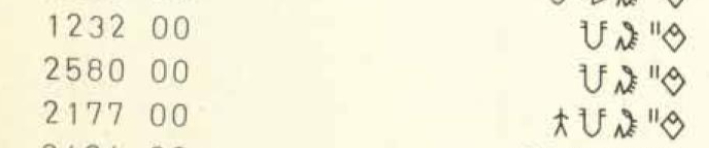
Mahadevan 1977 Concordance
Inscription 2177: Shakti Pitha (Temple of Shakti, wife of Shiva)
Inscription 2177: The body and mind: Temple of Man
House. Of. Spine / skeleton / bodyh. Third eye tilak, mind. Man.
Temple of Sati (self-immolated, skeleton) and Shiva
PR (Egyptian) puram
TR TIRTHA crossing place, holy place. Glyph X 144, 149 XX, 150, 284, 285
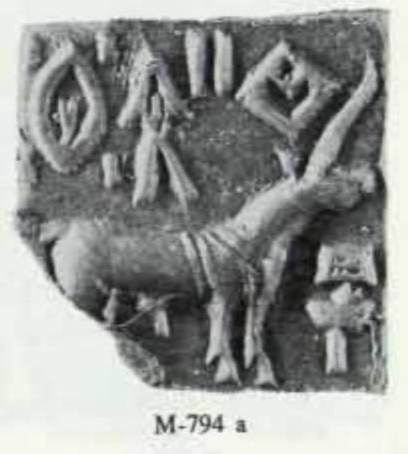
TEMPLE of Shiva (third eye) and Vishnu (lotus navel)
HOUSE of Shiva and Vishnu. Family name. Address.
Full moon of Shiva and Vishnu. Occasion. Calendrics
((( OM ))) Shiva and Vishnu

House of Kama (love) / Dharma (life)
Dharma = ) bow + | bowstring
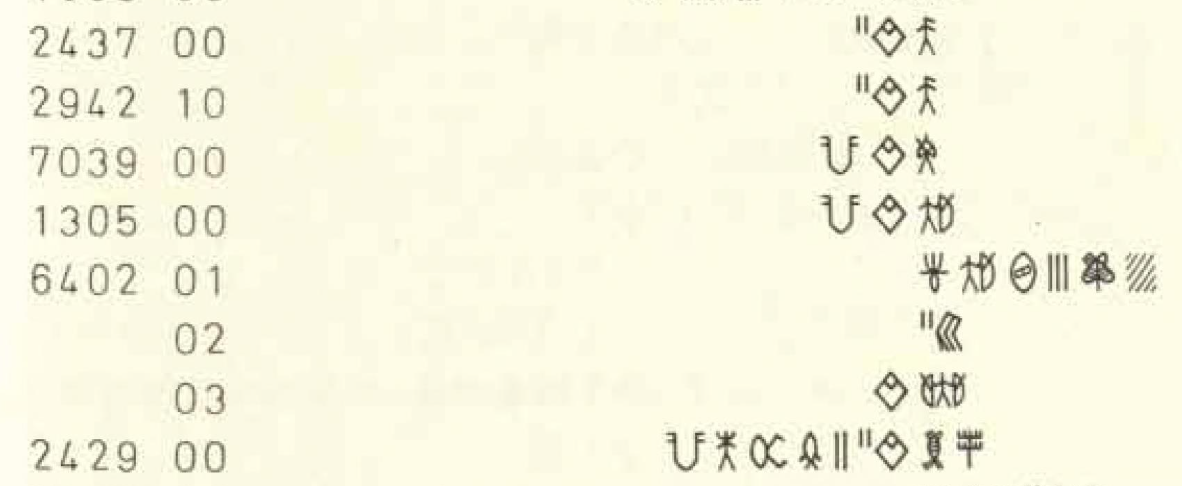
Horsehead demon house, moving in orbit.
Horsehead Vishn heavenly abode, Vaikuntha
Horsehead wisdom god Ashwini, House of wisdom, library?

Inscription 5480: One house for three. Trimurti
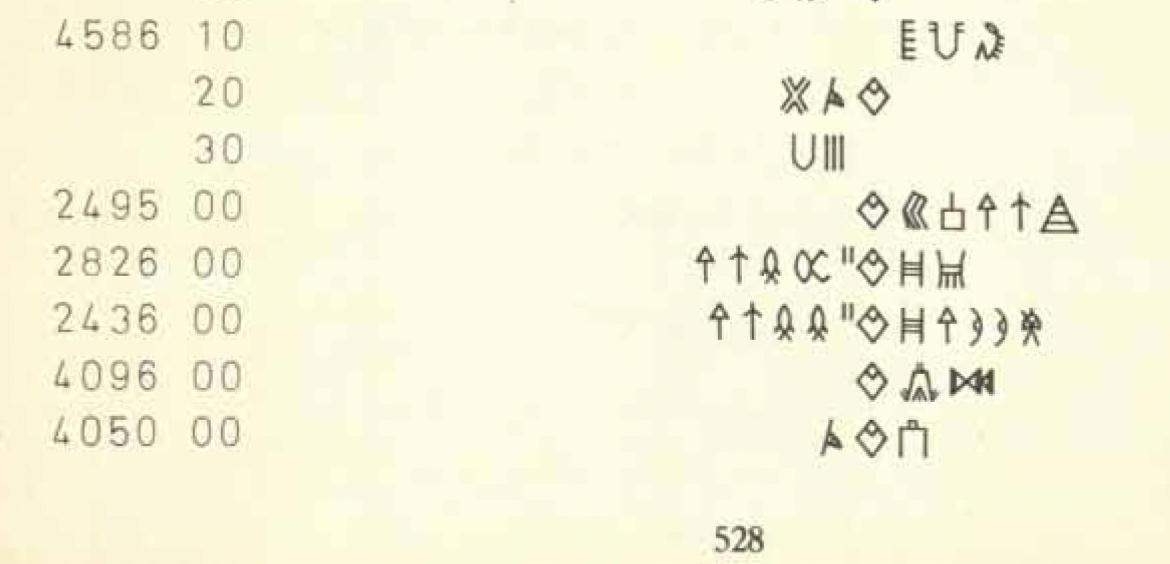
Inscription 4050: Head house mouth. Head #197 with Brahminical shikha topknot. #267 house. #402 mouth, throat.
Inscription 4586: Parva Story of X destruction. Sati Daksha Yajna destruction

Inscription 8072: Vishnu dwarf avatar expands to cosmic size. At top #126 of the sky,
he punctures the cosmic egg #373 with his toe #341. Divides the one #94. \\ | Breaks the
cosmic egg. Lets in the sacred water of the Ganga river which flow to Brahma's kamandala
until brought to earth the the descendent of King Sagara. Sa Sweet and sour. Born with
poison. Sea and freshwater contrast. Wisdom, discrimination. Alchemy
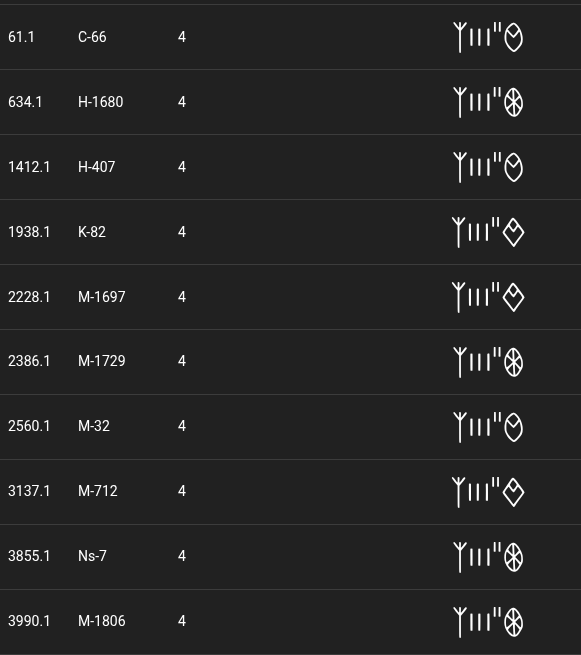
Indusscript.net query results
OM Shiva variants: OM 3 representing Shiva, trishul representing Shiva . CCH
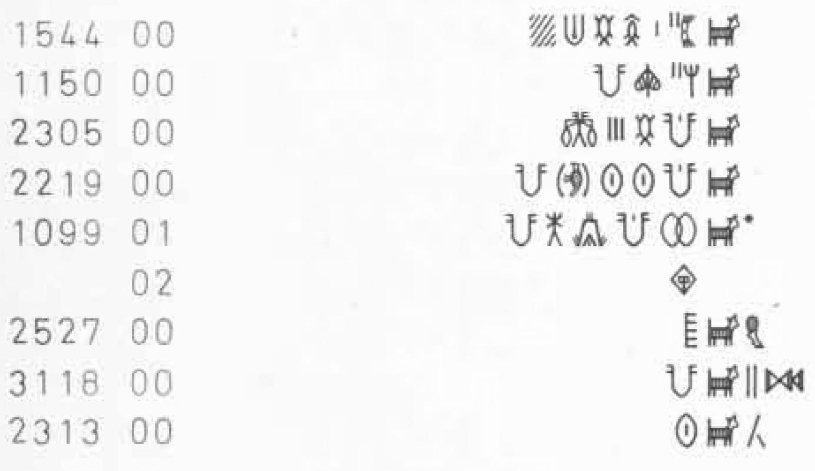


Glyph #176: endless, infinite. Glyph #50: Wish-fulfilling cow, Kamadhenu. Glyph #84 cow legs. The four legs
of Kamadhenu represent the four vedas, and the fundamental elements. Kamadhenu represents endless abundance.

|
ENDLESS PILLAR - THE SHIVA LINGA. Glyph #176: endless pillar. #81 The bird (swan) avatar of god Brahma. In the legend of Jyotirlinga, Brahma had a contest with Vishnu to see which would be first to discover the end of a mysterious flaming pillar of fire. Brahma flew up with his bird avatar (#81), and Vishnu dug down with his boar avatar (#62). Glyph #418 (or glyph #0) specified by Celeste Horner 2024 to extend the 417 glyph system of Mahadevan 1977 by one character. This dot, bullet point, iris, or bindu character • is a null, void, or negative. It represents Shiva's function of annihilation, and the case that the endless linga has no end, so both Brahma and Vishnu failed in their quest to determine the limits. Glyph #219 is Mount Meru with a vertical bisector representing Shiva as the axis of the world. In a contest between Naga serpent Vasuki and Vayu, the wind, a spur was broken off of Mount meru. This became Mount Mandan, the giant churning rod #336 twisted by devas (the gods) and asuras (the demons) during the Churning of the Ocean of Milk. Glyph #343 is a variant of the Shiva symbol #342, the most frequent glyph in the Indus Script. With a short stroke in the center, it represents the Shiva lingam, or the divided Ardhanarishwar half male, half female form of Shiva.
|
Shiva and the pillar of fire, Jyotirlinga
|
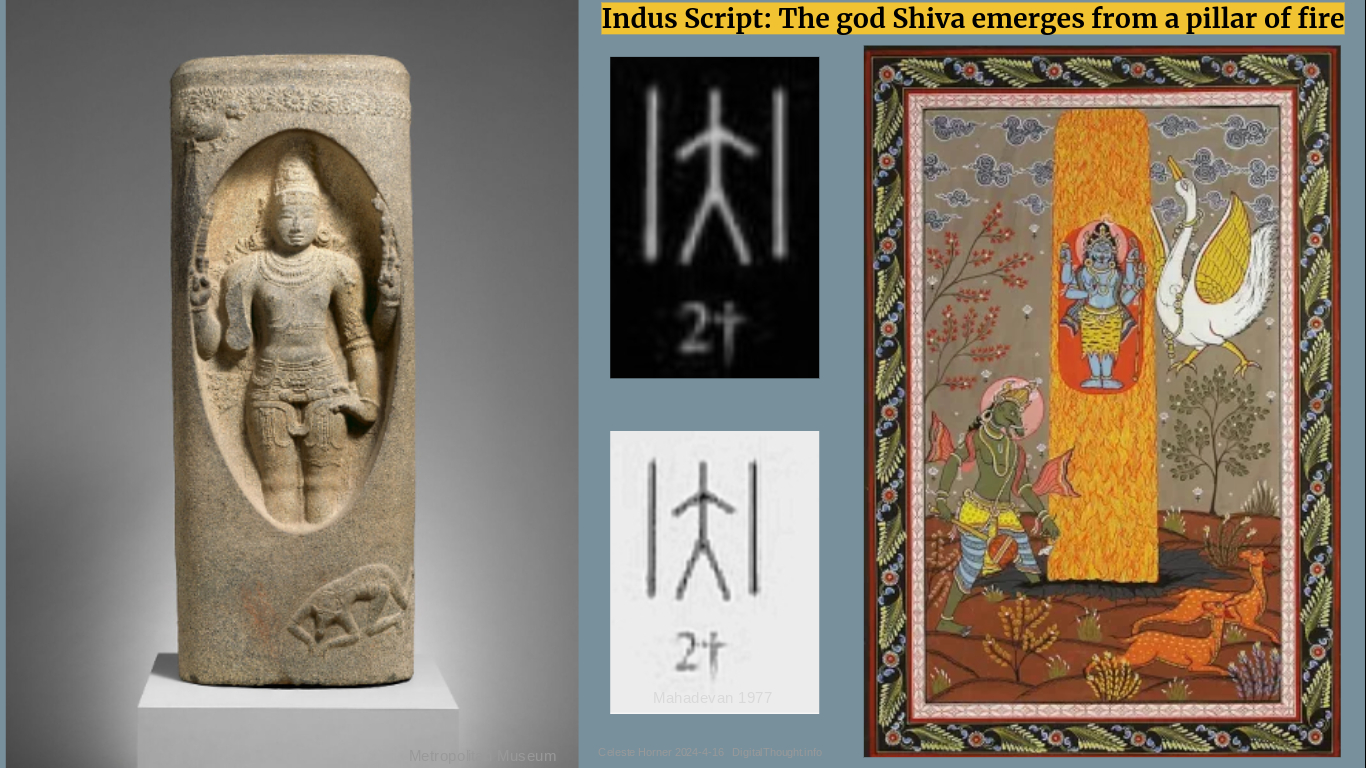
Image credits: Metropolitain Museum and Indianholiday.com
|
GLYPH #2: JYOTIRLINGA - GOD SHIVA EMERGES FROM A PILLAR OF FIRE
Indus Script glyph #2. @ HOW BRAHMA LOST HIS FIFTH HEAD. A dispute arose between gods Brahma and Vishnu over who was the greatest.
Suddenly, an enormous pillar of light and fire blazed up between them. They agreed that whoever could discover the end would be declared superior. Brahma transformed into a swan (#63, #64) and flew upwards. Vishnu in the form of his boar avatar (glyph #62, also Matsya god fish with tusk) dug down towards the netherworld. Both gods searched, but neither could find the end of the pillar. When they met again, Vishnu admitted truthfully that he failed to find the bottom. Brahma, however, lied and produced a flower that he said came from the top. Just as Vishnu was about to bow to him, the god Shiva emerged from the pillar in a rage, and with a blade of grass, sliced off the 5th head of Brahma which had swollen his ego and caused him to lie (#79, headless bird #83, #198, #51, #52). After that, it is was apparent that Shiva was the supreme deity. Jyotirlinga (radiant linga) shrines (#267, #270-283) across India are honored as emanations of this first manifestation of Shiva as a cosmic pillar of light (#61). Shiva Puranas, Chapter 7
Concordance entries for glyph #2: @ | @ ♣ | Glyph #2 info page
|
Indus Script deciphered with Hindu mythology: glyph #48, the corpse
THE TRAGIC DEATH OF SATI
| |
|
Figure 1. Indus Script glyphs deciphered by Celeste Horner 2024. Shiva art by Kala Kshetram @Tumbler 2026 update: #99 glyph is "of"
Indus Seal M-15 refers to the Hindu shrines dedicated to Sati, the first wife of the god Shiva. She sacrificed herself in fire because her father, a king, disrespected her husband. Indus Script glyph #48 depicts a corpse, with vertebral spines protruding from the back. In this story, these strokes also suggest robes, funeral wrapping, and flames. Glyph #48 also appears Ardhanishwara legend of the three-legged skeleton man, to describe Shiva as a god of the dead, and to represent the noose, called pashu with which the death god Yam extracts souls from their bodies at the end of life. The name of Shiva as Pashupati, Lord of Animals, may be written with glyph #48.
Indus Script glyph #48. SATI DIED TRAGICALLY. She married Shiva, God of Destruction against the wishes of her father, a king. He did not want his beautiful princess daughter to marry a poor, matted-hair ascetic who was covered with crematorium ash and writhing snakes. To show his contempt, the king hosted an elaborate sacrificial banquet and invited all the gods of the universe, except Shiva. Sati went to the event, dispite not being invited. When she appeared, her own father mocked her husband, and humiliated her. In protest, unwaveringly loyal to her husband Shiva, Sati walked into the sacrificial fire and died.
Shiva arrived in a consuming rage and destroyed the entire place. After that, he staggered around the land like a mindless drunken man, agonizing in bottomless grief, carrying the body of his dead wife. He was oblivious that parts of her corpse fell to the ground. His trail of tears became a pilgrimmage route in India to this day. Each part of Sati's body that fell has a Shakti peeta shrine and letter of the Sanskrit alphabet dedicated it, so that her memory will never die. Finally Shiva's grief gave way to anger, and he started the fatal steps of his Tandava dance that had the power to destroy the universe. At that point, Vishnu, the God of Preservation intervened. He attacked Shiva with his whirling sawtooth Sudarshan chakra, one of the ultimate weapons of the gods. It vaporized the remaining crumbs of Sati's corpse, and knocked the destructive winds out of Shiva. His mind restored, Shiva walked into a forest, sat down, and meditated motionless -- for centuries.
|

Varuna rides a Makara and holds a pasha noose (glyph #48)
Image credits: Metropolitain Museum and Indianholiday.com. The Indus Script: text, concordance, and tables. Mahadevan, I (1977)
|
Indus Script glyph #2. @ How Brahma lost his fifth head. A dispute arose between gods Brahma and Vishnu over who was the greatest.
Suddenly, an enormous pillar of light and fire blazed up between them. They agreed that whoever could discover the end would be declared superior. Brahma transformed into a swan and flew upwards. Vishnu in the form of his boar avatar dug down towards the netherworld. Both gods searched, but neither could find the end of the pillar. When they met again, Vishnu admitted truthfully that he failed to find the bottom. Brahma, however, lied and produced a flower that he said came from the top. Just as Vishnu was about to bow to him, the god Shiva emerged from the pillar in a rage, and sliced off the 5th head of Brahma which had swollen his ego and caused him to lie. After that is was apparent that Shiva was the supreme deity. Jyotirlinga (radiant linga) shrines across India honor this first manifestation of Shiva as a cosmic pillar of light.

Glyph #48: corpse, spine. Endless - Shiva - Spine. Shiva is the infinite axis of the cosmos


X: crossing over, reincarnation -- an endpoint
The knife, the blade -- an endpoint
The corpse, the grave -- an endpoint
Shiva -- Endless
|


Glyph 48 applied by CCH 2024 to Indus Script discussion by Rig - History Extended 2024

Hindu mythology interpretation of the Indus Script
Celeste Claire Horner 2024
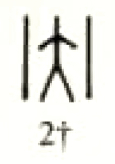 | Jyotirlinga, the pillar of fire from which Shiva emerged in the legend of How Brahma lost his fifth head |
| U | universal, union.
Third eye tika. Shiva wallowed poison from Ocean of Milk. |
| |||| | Represents the Ganga river falling from heaven. Shiva saved the world by absorbing the impact of the water fall. It flows gently from the top-knot of his hair. |
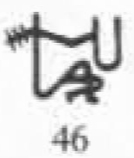 |
The lovely divine maidens, celestial musicians and dancers, the Apsaras, who emerged from the Ocean of Milk. Shiva saved the world by swallowing the poison which emerged from the Ocean of Milk so that the Devas could have the Amrita elixir of immortality and other treasures. The goddess Lakshmi, divinity of wealth and fortune, may be represented by this symbol. She has a special connection to Shiva. The Bael tree which sprouts from her hand, and the fruit, which represents her also, are sacred to Shiva. |
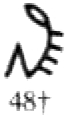 |
The dead. Skeleton man. Corpse in fetal position with spinal vertebrae protruding. Death of Shiva's wife Sita in a sacrificial fire. The dead in a fetal position in anticipation of reincarnation and rebirth. Pashu, the noose that Yam, God of Death, uses to pull a soul from a body.
|
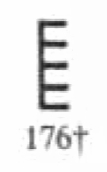 | E: Endless, deep and high. Represents the Jyotirlinga pillar of fire representing Shiva. The pillar of the cosmos, the gods Vishnu and Brahma failed to find the end of it. |
|||| Represents the depths of the Ocean of Milk
Glyph 171. Represents Ocean of Milk, or lord of the Oceans. 5-prong trident. Also appears as Neptune's 5-prong trident sceptre in Ephesus house. Alamy.
8059: Ψ Trishul. Jyotirlinga I. ||| Tri Murti, TRi. TRIMURTI.
How Brahma Lost His Fifth Head ^
|
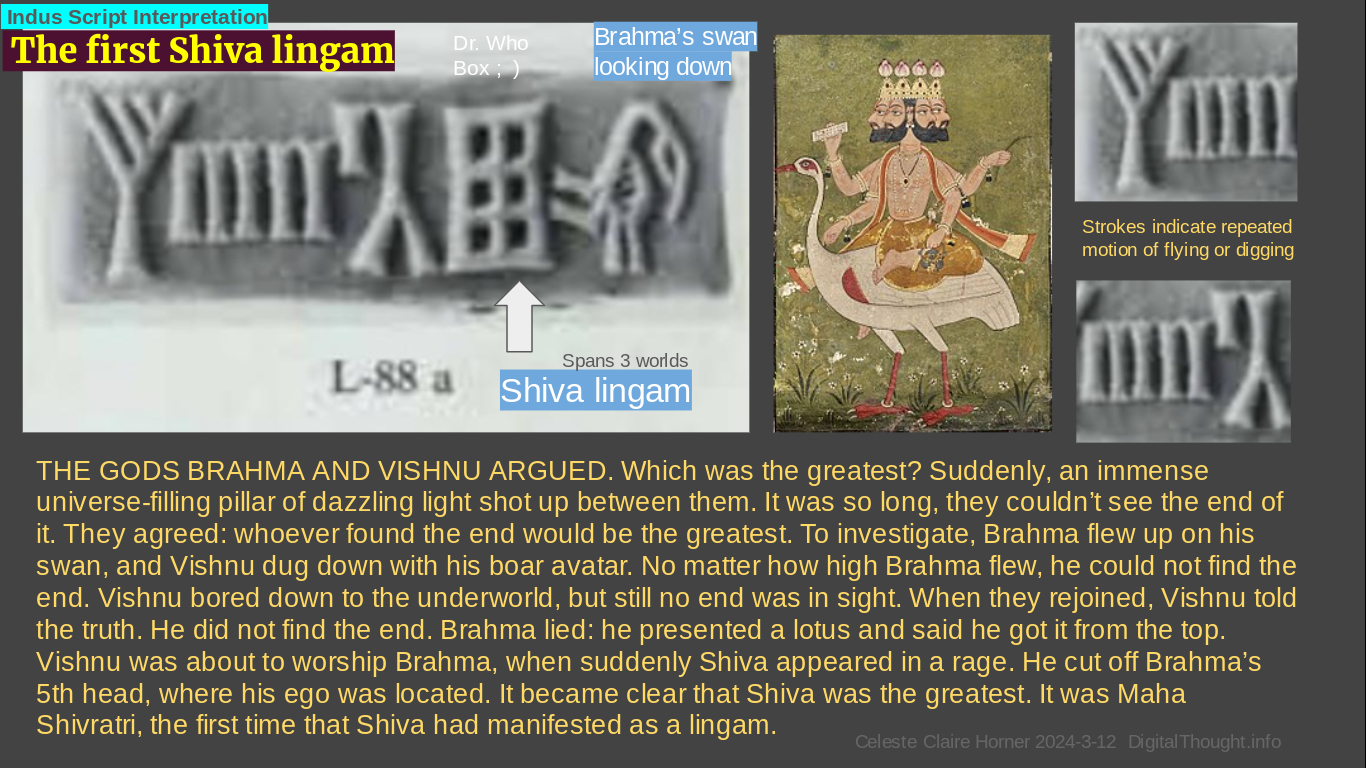
Figure 6: Indus Script with glyphs for a Shiva lingam, the swan of Brahma, and multiple strokes for digging and flying action. CCH 2024-3-12.
The swan's head is bent back like it is looking down from the tall tower, has lost its head, is dead, or ashamed. The head looks like the Egyptian hieroglyph for crescent moon, an emblem of Shiva. The upside down Y look like the Eiffel tower. The lingam was an infinite tower.
RELATED INDUS SCRIPT GLYPHS:
Glyphs #2 (Shiva appears in pillar). Glyph #5 (Brahma head). Glyph 79 (Brahma bird avatar looking down). Glyph #83 (Brahma bird avatar with no head). Glyph #198 (5th head of Brahma, 5th block on top of stack of 4).
|
[INDUS SCRIPT HOME]
DRAFT UPDATED 2026-11-5, 2026-11-1, 2024-5-19 @12:19 , CREATED 2024-5-17 celeste@digitalthought.info / celeste.horner@gmail.com
|
| |